

What size bicycle for 8 year old boy
For most 8-year-old boys, start by comparing 18-inch and 20-inch bicycles. Measure his height first: XBikes places 18-inch bikes at 43–52 inches (109–132 cm) and 20-inch bikes at 48–60 inches (122–152 cm). Then confirm stand-over room, reach, brake control and confidence on the actual bicycle.
Choose the starting size from measured height
Age points toward a likely range, but it does not determine fit. According to the XBikes starting points, both 18-inch and 20-inch wheels can suit some eight-year-olds. The rider’s current measurements and control decide which one deserves a trial.
| Wheel size | XBikes age starting point | XBikes rider-height starting point | What it means here |
|---|---|---|---|
| 18 Inch | Ages 5–9 | 43–52 in / 109–132 cm | A relevant starting point for a shorter eight-year-old. |
| 20 Inch | Ages 7–12 | 48–60 in / 122–152 cm | A relevant starting point when the child is at least 48 inches / 122 cm tall. |
| 24 Inch | Ages 10–14 | 54–64 in / 137–163 cm | Usually an older-child starting point; consider it only when height and an individual fit check support it. |
If he is 48–52 inches (122–132 cm), the height ranges overlap. Do not automatically choose 20 inches. Have him try both sizes and select the bicycle on which he can stand over, reach, steer and operate the brakes with better control.
Measure height and inseam before shopping
- Height: Have the child stand straight without shoes against a wall. Measure from the floor to the top of his head, then compare that result with the XBikes ranges above.
- Inseam: With shoes off and feet slightly apart, measure from the floor to the crotch. Use this measurement when checking the bicycle’s stand-over space and saddle adjustment; wheel size alone does not reveal frame clearance.
Record both measurements rather than relying on clothing size or a previous bicycle. Different bicycles with the same wheel diameter can still feel different because wheel size is not a complete description of frame fit.
Perform the fit check with the child
The American Academy of Pediatrics’ HealthyChildren guidance supports having the child try the bicycle and avoiding an oversized purchase intended merely for future growth. During the trial, check these points:
- He can straddle the frame without it pressing into him.
- He can reach the handlebar without an uncomfortable stretch or cramped posture.
- He can steer smoothly while remaining balanced and looking ahead.
- His hands can reach and operate the brake controls reliably.
- Starting, stopping and turning feel manageable at his current confidence level.
If he meets a height range but cannot manage these checks, that bicycle is not a good current fit. A larger wheel should not be treated as an upgrade when it reduces control.
How the supplied 20-inch and cruiser options help
The supplied catalog gives one fixed 20-inch option and one model offered in 20-, 24- and 26-inch labels. They help you compare a likely eight-year-old starting size with larger alternatives, but neither catalog listing replaces measurement or an in-person fit check.
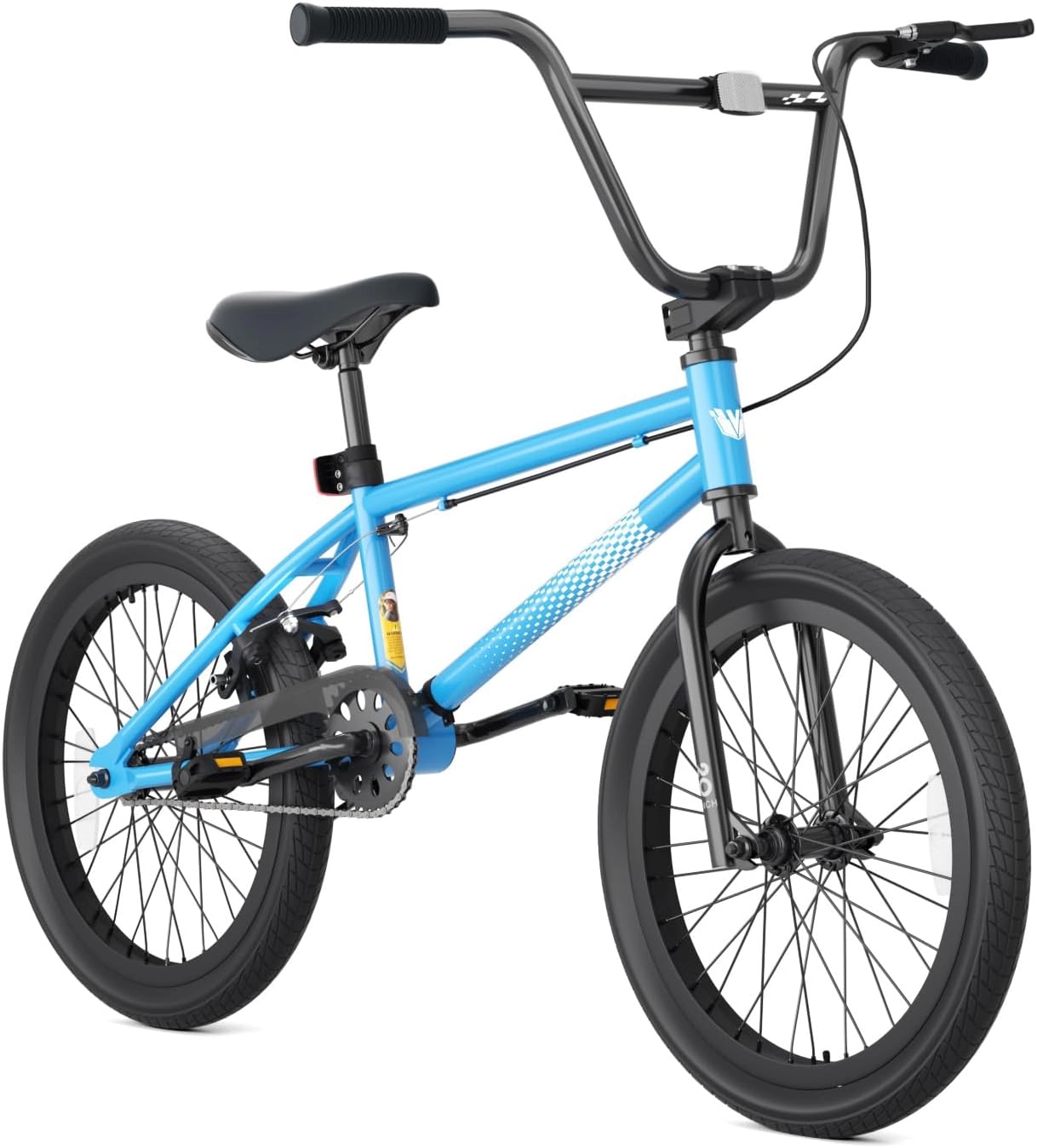 Blue XJD Freestyle BMX Bike, 20-Inch – No Pegs
A 20-inch Kids’ BMX Bikes option relevant when the rider falls within the supplied 48–60 inch height starting range and passes an individual fit check; the catalog specifies no pegs.
 XJD Kids Beach Cruiser Bicycle, Rear Rack & V-Brakes, Mint Green
A Beach Cruiser Bikes comparison offered in 20-, 24- and 26-inch labels. For many eight-year-olds, the 20-inch version is the relevant starting comparison, subject to measured height and fit.
Blue XJD Freestyle BMX Bike, 20-Inch – No Pegs is a Kids’ BMX Bikes catalog option with a 20-inch wheel designation and no pegs. It is relevant when the rider measures within the 20-inch starting range, but its “Default” SKU label supplies no additional fit choice. Confirm stand-over, reach and control on that exact bicycle.
XJD Kids Beach Cruiser Bicycle, Rear Rack & V-Brakes, Mint Green is a Beach Cruiser Bikes option offered with 20 Inch, 24 Inch and 26 Inch SKU labels. For an eight-year-old, the 20-inch version is the direct catalog comparison when his height supports it. The 24-inch version starts at 54 inches (137 cm) under the XBikes standard and still requires a successful fit check. The 26-inch version is a youth-and-adult starting point for riders over 60 inches (153 cm), so it should not be chosen merely to allow room for growth.
No supplied product has an 18-inch option. If measurement and control indicate 18 inches, these products are comparison points, not substitutes for an 18-inch bicycle.
Check safety and setup before riding
Use a bicycle helmet that fits properly, sits level and has its straps adjusted according to the helmet manufacturer’s instructions, as advised by the U.S. Consumer Product Safety Commission. Recheck helmet fit whenever straps are adjusted.
For assembly, maintenance, adjustment limits, load limits, compatibility and torque, follow the exact product manual or ask a qualified bicycle mechanic. Before the first ride, confirm that the child can use the bicycle’s controls in a quiet, controlled area.
Make the decision
Measure the eight-year-old boy now. If he is 43–52 inches, trial an 18-inch bicycle; if he is 48–60 inches, trial a 20-inch bicycle. In the overlap, compare both. Buy only the size he can presently straddle, reach, steer and brake with confidence—not the larger size you hope he will grow into.
Bikes for your next adventure
-

XJD Girls Bike for Kids Ages 3-8, 12/14/16 Inch with Training Wheels – Purple
The XJD Girls Bike in Purple is a training-wheel bicycle for kids ages 3 to 8, f…$149
$169 -

Light Purple XJD Toddler Bike Helmet, Adjustable, Size XS (46–51 cm)
This Light Purple XJD toddler bike helmet is made for the smallest riders — the …$20.39
-

Black XJD Toddler Bike Helmet, Adjustable – Kids' Protective Helmet
The XJD Toddler Bike Helmet in black is an adjustable protective helmet for kids…$20.39