

What size bike for a 10yr old boy
For a 10-year-old boy, start by comparing 20-inch and 24-inch bikes: use his measured height and an individual fit check, not age alone.
Choose the starting wheel size by height
At age 10, a child may fall into either of two XBikes size ranges. A 20-inch bike is the starting point for riders 48–60 inches (122–152 cm) tall and ages 7–12. A 24-inch bike starts at 54–64 inches (137–163 cm) and ages 10–14.
The ranges overlap, so height narrows the choice but does not settle it. A rider between 54 and 60 inches (137–152 cm) should try both sizes. Choose the bike he can stand over, steer, start, stop and brake confidently. Do not move to 24 inches merely because he has turned 10 or because it leaves more room to grow.
| Measured rider height | Size to investigate | What to do next |
|---|---|---|
| 48–53 inches (122–136 cm) | 20-inch | Perform the complete fit check |
| 54–60 inches (137–152 cm) | 20-inch and 24-inch | Compare both in person |
| 61–64 inches (155–163 cm) | 24-inch | Perform the complete fit check |
| Over 60 inches (153 cm) | 26-inch is also a starting point | Compare fit, reach and control carefully |
Because the XBikes ranges overlap, the table is a shortlist rather than a promise that every frame with that wheel size will fit.
Measure him before comparing bikes
Measure without shoes and record the result rather than estimating from clothing size or a previous bicycle.
- Height: Have him stand straight against a wall, with feet flat and looking ahead. Measure from the floor to the top of his head.
- Inseam: Have him stand with feet slightly apart. Measure from the floor vertically to the crotch, using a firm book held level to represent the saddle contact point.
- Current confidence: Note whether he starts, turns, stops and uses the brakes smoothly, or still needs frequent foot contact and reassurance.
Use height to select the likely wheel range, then take both measurements to the product listing, manufacturer information or shop. Wheel diameter alone does not reveal frame stand-over height, saddle range or cockpit reach.
Run the fit check on the actual bike
The American Academy of Pediatrics guidance supports having the child try the bicycle and avoiding an oversized purchase for future growth. On the exact bike being considered, check the following:
- He can stand over the frame without the bicycle pressing uncomfortably into him.
- He can get on and off without losing balance or having to tip the bike excessively.
- From a normal riding position, he can reach the handlebar without stretching, locking his elbows or hunching forward.
- He can turn the handlebar while remaining balanced and in control.
- His hands can reach and operate the brake controls reliably, where fitted.
- He can start, pedal, slow and stop in a quiet, supervised area without the bike feeling cumbersome.
If he cannot complete those checks calmly, the bike is too large or otherwise unsuitable even when its wheel size matches his age and height range. If both 20-inch and 24-inch bikes pass, favor the one on which his control and brake operation are more natural.
How the supplied BMX option fits this decision
The supplied catalog option is the Blue XJD Freestyle BMX Bike, 20-Inch – No Pegs. Its verified relevance is specific: it is a 20-inch product in the Kids' BMX Bikes category, so it can be considered when the rider falls within the 20-inch starting range and wants a BMX-category bike. “No Pegs” is part of its exact catalog title; no additional component or compatibility assumptions should be made from that wording.
This particular catalog option helps answer the title by providing a concrete 20-inch comparison for a 10-year-old who measures 48–60 inches (122–152 cm). It is not evidence that every 10-year-old fits it, and it does not replace comparison with a 24-inch bike when the rider is in the overlapping height range.
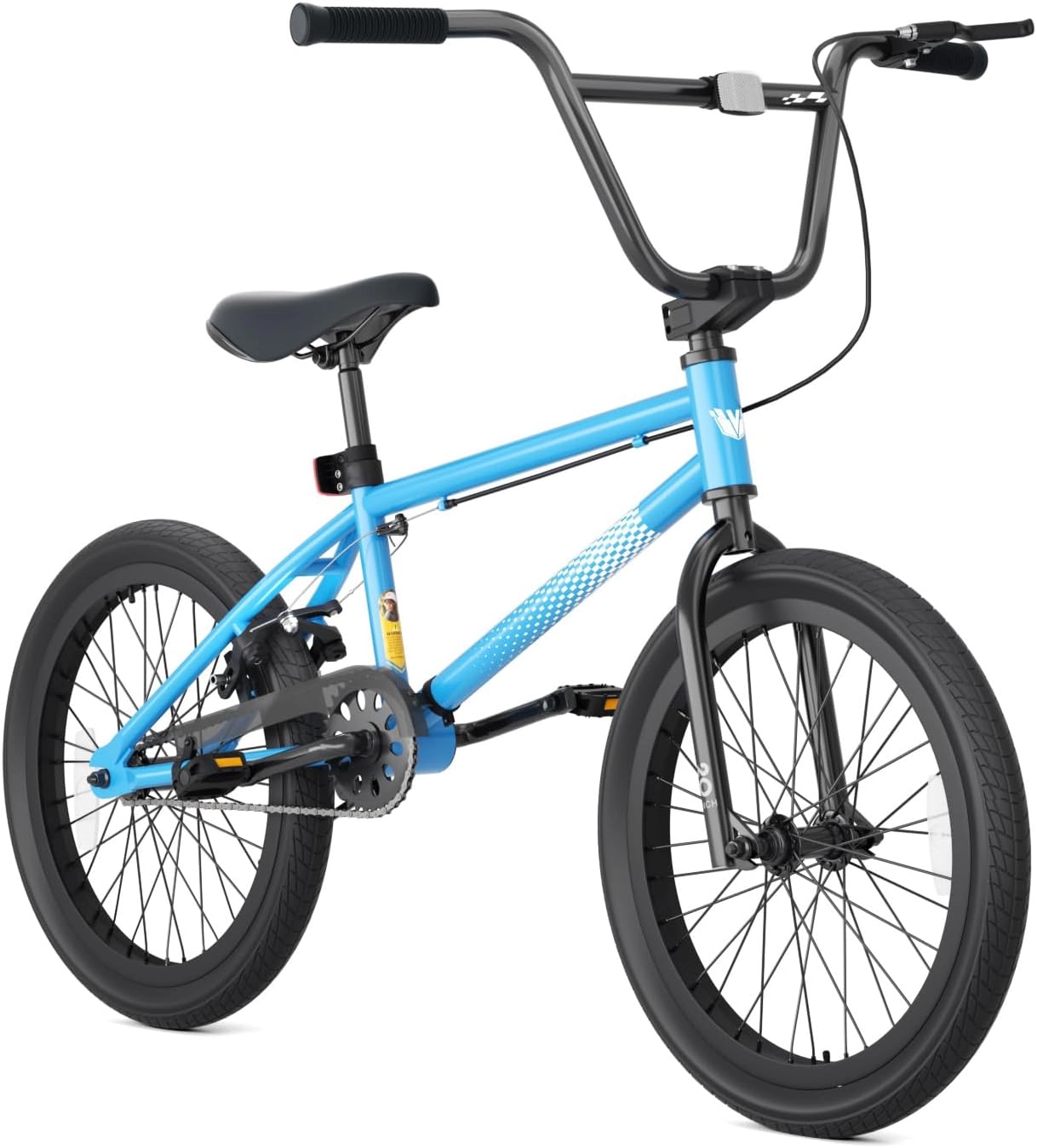
No 24-inch product was supplied here. Therefore, the displayed 20-inch BMX bike is a relevant comparison point, not a substitute for trying an appropriate 24-inch model when his measurements and control make that size a candidate.
Check setup, brakes and helmet before riding
Confirm that the saddle and controls can be adjusted to the child without exceeding marked limits. For assembly, maintenance, load limits, compatibility and torque, follow the exact product manual or ask a qualified bicycle mechanic; those details cannot be inferred from wheel size or category.
Have him demonstrate that he can operate the brakes before riding beyond the fit-check area. He should also wear a bicycle helmet that fits properly, sits level and has its straps adjusted according to the helmet manufacturer’s instructions, consistent with U.S. Consumer Product Safety Commission guidance.
The decision for this 10-year-old
Measure his height and inseam today. Begin with a 20-inch bike at 48–53 inches, compare 20-inch and 24-inch bikes at 54–60 inches, and begin with a 24-inch bike at 61–64 inches. Buy only after he passes the stand-over, reach, steering and brake-control checks on that exact bicycle—never size up solely for growth.
Bikes for your next adventure
-

Black XJD Kids Bike for Boys – 12, 14 & 16 Inch Sizes
For a son between roughly 3 and 8 years old, the XJD Kids Bike in Black covers t…$169
$199 -

Light Purple XJD Toddler Bike Helmet, Adjustable, Size XS (46–51 cm)
This Light Purple XJD toddler bike helmet is made for the smallest riders — the …$20.39
-

Black XJD Toddler Bike Helmet, Adjustable – Kids' Protective Helmet
The XJD Toddler Bike Helmet in black is an adjustable protective helmet for kids…$20.39