

What size bike for a 10-year-old boy
For a 10-year-old boy, start by comparing 20-inch and 24-inch bikes. Choose by measured height and fit, not age: 20-inch suits 48–60 in (122–152 cm), while 24-inch suits 54–64 in (137–163 cm).
Choose the starting wheel size from his height
Age ten falls within both XBikes starting ranges, so age alone cannot settle the choice. Measure him without shoes, standing straight against a wall, and compare the result with this compact guide.
| Wheel size | XBikes age starting point | Rider height starting point |
|---|---|---|
| 20 Inch | Ages 7–12 | 48–60 in / 122–152 cm |
| 24 Inch | Ages 10–14 | 54–64 in / 137–163 cm |
| 26 Inch | Youth and adults | Over 60 in / 153 cm |
If he is below 54 inches (137 cm), a 20-inch bike is the more relevant starting point. From 54 to 60 inches (137–152 cm), both ranges overlap, so the individual fit check decides. Above 60 inches (153 cm), compare 24-inch and 26-inch options rather than assuming either will fit.
Measure inseam as well as total height
For inseam, have him stand without shoes with his feet slightly apart. Place a straight-edged book firmly between his legs, level with the floor, then measure from the floor to the top edge. This number helps you assess clearance when he stands over a particular bicycle; it does not convert automatically into a wheel size.
Have him straddle the actual bike with both feet on the ground. He should have usable clearance and should not be pressed against the frame. Frame shapes differ, which is why two bicycles with the same wheel diameter can fit differently.
Check reach, braking and confidence on the actual bike
A promising height range is only the first filter. With the seat adjusted according to the exact product manual, ask him to hold the handlebar and operate the controls. He should not need to stretch, twist his wrists awkwardly or slide forward simply to reach them.
- Can he mount and dismount without struggling?
- Can he steer at low speed while looking ahead?
- Can he reach and operate the brakes confidently?
- Can he start, stop and place a foot down under control?
- Does the bike feel manageable rather than intimidating?
If any answer is no, do not size up merely to leave growing room. A smaller bike that he can control now is more appropriate than an oversized one he may eventually grow into. Current skill matters too: a less-confident rider may need the easier-to-control fit even where height ranges overlap.
How the supplied XBikes options compare
The catalog provides one 20-inch option and two products with 24-inch versions, so these particular choices make the title’s decision concrete: compare the smaller starting point with the larger one, then confirm stand-over, reach and control in person.
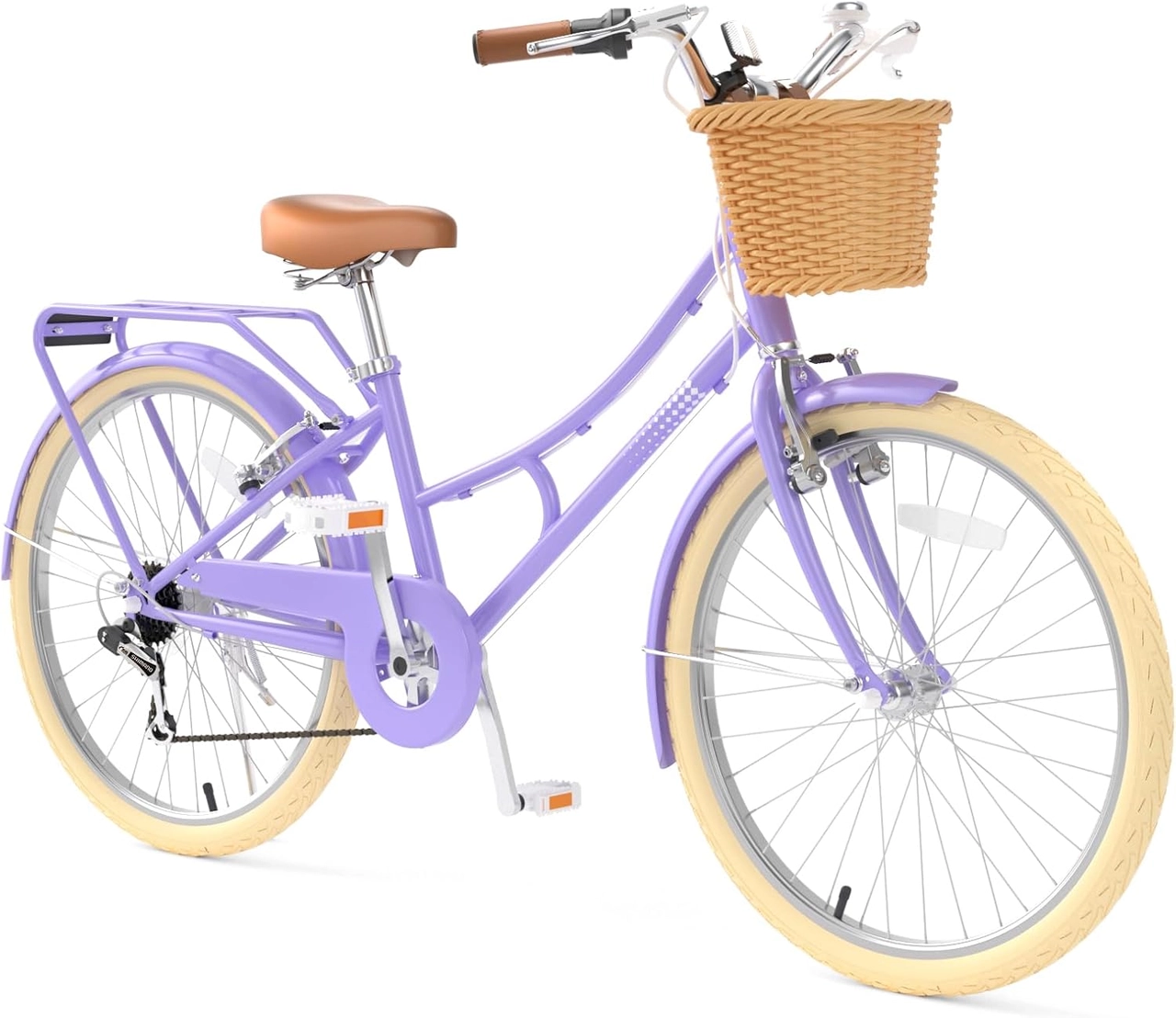 24-Inch Purple XJD Beach Cruiser Bike with U-Brake
A supplied 24-inch cruiser comparison for riders who meet the 54–64 in starting range and pass individual stand-over, reach, braking and control checks.
 Blue XJD Freestyle BMX Bike, 20-Inch – No Pegs
The supplied 20-inch option, relevant to the 48–60 in height starting range and especially useful when a 24-inch bike is too large to control comfortably.
 XJD 24-Inch Green Beach Cruiser Bike with U-Brake
Offers listed 24-inch and 26-inch SKU labels for size comparison; each must be treated as a distinct wheel size and checked against measured height and individual fit.
The 20-inch comparison
The Blue XJD Freestyle BMX Bike, 20-Inch – No Pegs is the supplied 20-inch option. Its wheel size corresponds to the XBikes 48–60 in (122–152 cm) starting range. It is relevant when the rider is under 54 inches, or when a rider in the overlap cannot comfortably manage a 24-inch bike. “No Pegs” is part of the supplied catalog description, not evidence of fit.
The 24-inch comparisons
The 24-Inch Purple XJD Beach Cruiser Bike with U-Brake and the 24-inch version of the XJD 24-Inch Green Beach Cruiser Bike with U-Brake match the 24-inch starting point of 54–64 in (137–163 cm). They become relevant once his measured height reaches 54 inches, provided he also passes the stand-over, reach, brake-control and confidence checks.
The second cruiser lists Green / 24 Inch, Pink / 24 Inch and Pink / 26 Inch SKU labels. The 26-inch version is a separate size, not an equivalent substitute for a 24-inch bike, and the XBikes starting point for 26 inches is over 60 inches (153 cm). Color labels do not affect the fit decision.
What to do before choosing
- Measure his standing height and inseam without shoes.
- Use 20 or 24 inches as the initial comparison, based on the height ranges above.
- Have him try the exact bicycle and check stand-over clearance, reach, braking and low-speed control.
- Reject any bike that is oversized for growth or difficult for him to control today.
- Follow the exact product manual for assembly, adjustment, maintenance, compatibility and load limits, or use a qualified bicycle mechanic where needed.
Finish the setup with a properly fitting bicycle helmet. It should sit level, and its straps should be used according to the helmet manufacturer’s instructions.
The decision for a 10-year-old boy
Choose 20 inches if his measured height and current control point there; choose 24 inches only when he is at least 54 inches (137 cm) and can comfortably stand over, reach, steer and brake on that exact bike. In the 54–60 inch overlap, let the successful hands-on fit check—not his tenth birthday—make the final decision.
Bikes for your next adventure
-

Light Purple XJD Toddler Bike Helmet, Adjustable, Size XS (46–51 cm)
This Light Purple XJD toddler bike helmet is made for the smallest riders — the …$20.39
-

Black XJD Toddler Bike Helmet, Adjustable – Kids' Protective Helmet
The XJD Toddler Bike Helmet in black is an adjustable protective helmet for kids…$20.39
-

XJD Girls Bike for Kids Ages 3-8, 12/14/16 Inch with Training Wheels – Purple
The XJD Girls Bike in Purple is a training-wheel bicycle for kids ages 3 to 8, f…$149
$169