

What size bike for a 12-year-old boy
For most 12-year-old boys, start by comparing 20-inch and 24-inch bikes: 20-inch suits riders 48–60 in (122–152 cm), while 24-inch suits 54–64 in (137–163 cm). Measure him and confirm the fit on the actual bike before choosing.
Choose by height, not by his 12th birthday
Age places a rider near a likely wheel-size range, but it does not settle the decision. In the XBikes starting points, both 20-inch bikes (ages 7–12) and 24-inch bikes (ages 10–14) include age 12. Their height ranges overlap from 54 to 60 in (137 to 152 cm), so two boys of the same age may need different sizes.
| Measured rider height | Size to compare first |
|---|---|
| 48–53 in (122–136 cm) | 20 Inch |
| 54–60 in (137–152 cm) | Try both 20 Inch and 24 Inch |
| 61–64 in (155–163 cm) | 24 Inch |
| Over 60 in (153 cm) | 26 Inch is also an XBikes starting point; compare actual fit carefully where ranges overlap |
These are starting points, not guarantees. Frame geometry varies, and wheel diameter alone cannot confirm whether a bicycle fits.
Measure height and inseam
Measure his height without shoes, standing straight against a wall. Then measure his inseam: have him stand with feet slightly apart and measure from the floor to the crotch. Record both measurements rather than estimating from trousers or shoe size.
Use measured height to identify the likely wheel size above. Use inseam during the physical fit check to judge stand-over clearance and whether he can mount, stop and step down comfortably. The supplied standard does not provide an inseam-to-frame formula, so do not invent one or rely on wheel size as a substitute.
What to check on the actual bicycle
Have him try the exact bicycle, ideally with the seat and controls adjusted according to its manual. The correct choice should let him remain composed and in control, rather than stretching to operate the bike.
- Stand-over: He should be able to straddle the bicycle securely without the frame preventing a safe, comfortable stance.
- Reach: He should reach the handlebar without locking his elbows, leaning excessively or losing a stable riding position.
- Brake control: His hands must reach and operate the brake controls confidently while he maintains his grip.
- Starting and stopping: He should mount, set off, steer, stop and step down without struggling with the bicycle’s size.
- Confidence: If the larger option makes these actions hesitant or awkward, it is not the right choice simply because he may grow into it.
Do not buy an oversized bicycle for future growth. Present control matters more than extending the time before the next size change.
How the supplied XBikes options help
The catalog provides useful 20-, 24- and 26-inch comparison points around the sizes a 12-year-old may need. The XJD Kids Beach Cruiser Bicycle, Rear Rack & V-Brakes, Mint Green has 20 Inch, 24 Inch and 26 Inch SKU labels, allowing those wheel-size starting points to be compared within one listed model. Its rear rack and V-brakes are supplied catalog facts, but they do not establish fit.
The 24-Inch Purple XJD Beach Cruiser Bike with U-Brake is explicitly a 24-inch bicycle and lists a U-brake. It is relevant when the rider measures within the 24-inch starting range, but the “Default” SKU label provides no additional sizing choice. Brake type does not replace the required check that he can comfortably reach and operate the controls.
These particular catalog options help because they include the two main starting sizes for many 12-year-olds, while the first product also provides a 26-inch comparison for a taller rider. Neither product should be selected from its title, color or SKU label alone.
 XJD Kids Beach Cruiser Bicycle, Rear Rack & V-Brakes, Mint Green
Available with 20 Inch, 24 Inch and 26 Inch SKU labels, this model provides relevant comparison points across the likely height ranges. Its rear rack and V-brakes do not determine whether the bicycle fits the individual rider.
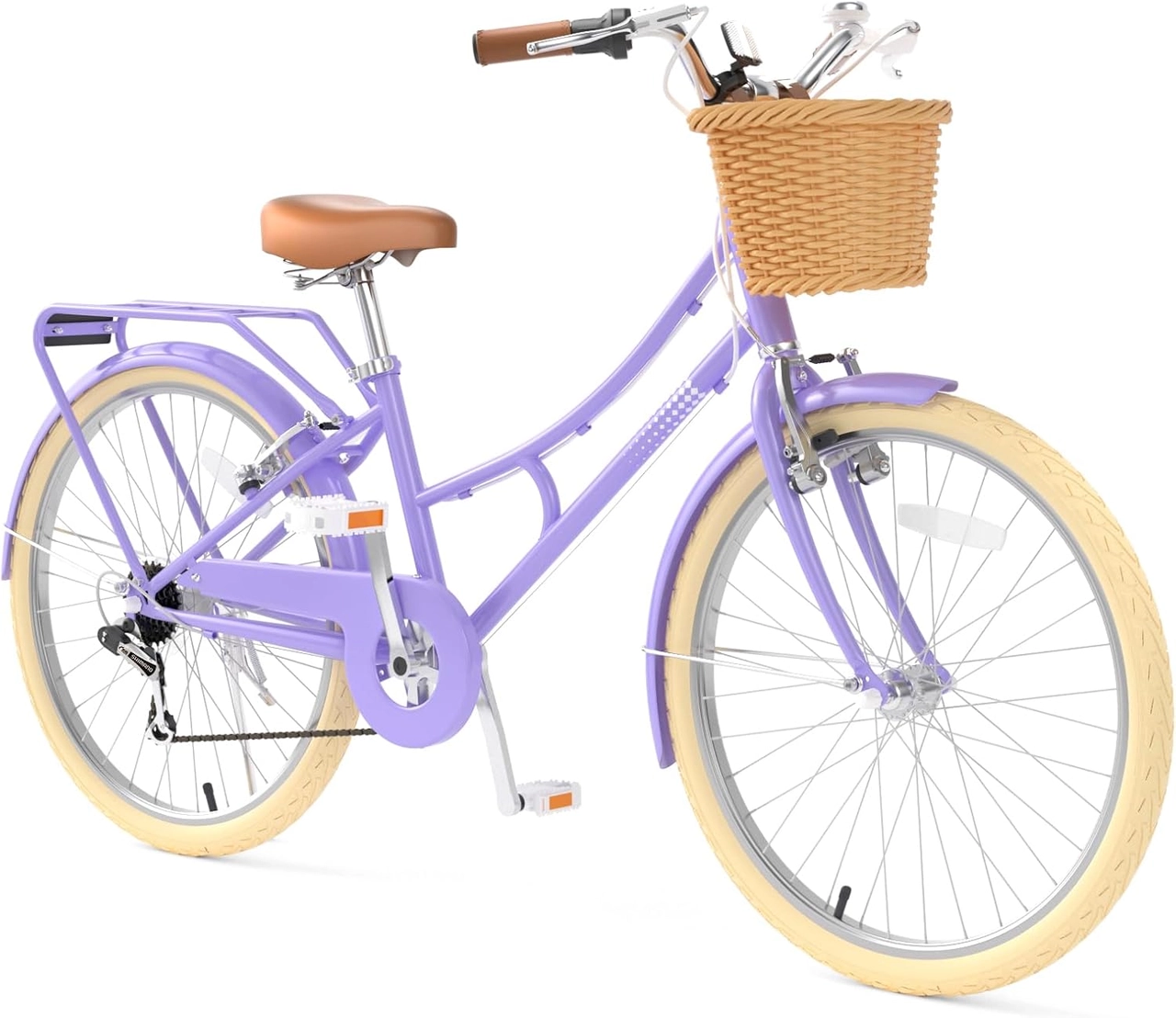 24-Inch Purple XJD Beach Cruiser Bike with U-Brake
This 24-inch bicycle is relevant for riders measuring 54–64 in (137–163 cm), subject to an individual fit check. Its U-brake must be comfortably reachable and controllable; the Default SKU label offers no further size information.
Make the final decision
- Measure his barefoot height and inseam.
- Use height to shortlist 20 Inch, 24 Inch or, if appropriate, 26 Inch.
- When he is 54–60 in (137–152 cm), compare both 20-inch and 24-inch bicycles rather than deciding from age alone.
- Have him try the exact bicycle and verify stand-over, reach, brake operation, starting, steering and stopping.
- Choose the size he controls confidently now; do not move up solely to leave growing room.
Before riding, fit a bicycle helmet so it sits level and secure its straps according to the helmet manufacturer’s instructions. Follow the exact bicycle manual or ask a qualified bicycle mechanic about assembly, maintenance, compatibility, load limits and torque.
For a 12-year-old boy, the next step is simple: measure him today, shortlist the matching wheel sizes, and buy only after he demonstrates comfortable control on the exact bike.
Bikes for your next adventure
-

XJD Girls Bike for Kids Ages 3-8, 12/14/16 Inch with Training Wheels – Purple
The XJD Girls Bike in Purple is a training-wheel bicycle for kids ages 3 to 8, f…$149
$169 -

Pink Girls' 12/14/16" Bike by XJD – Basket & Doll Seat
The XJD Pink Girls' Bike with Basket & Doll Seat is made for riders 71–122 cm ta…$75.99
$99.99 -

Light Purple XJD Toddler Bike Helmet, Adjustable, Size XS (46–51 cm)
This Light Purple XJD toddler bike helmet is made for the smallest riders — the …$20.39