

What size bike for a 8 yr old boy
For most 8-year-old boys, compare an 18-inch bike with a 20-inch bike. Choose by measured height and actual fit, not age or room to grow.
The quick size answer
XBikes uses 18-inch wheels as a starting point for ages 5–9 and heights 43–52 inches (109–132 cm). A 20-inch bike is the starting point for ages 7–12 and heights 48–60 inches (122–152 cm). That overlap means many 8-year-olds could fall into either range.
If he is below 48 inches (122 cm), begin the comparison with an 18-inch bike. From 48 to 52 inches (122–132 cm), try both 18-inch and 20-inch models and choose the one he controls more confidently. Above 52 inches (132 cm), start with a 20-inch bike. These are screening points, not guarantees.
Measure him before comparing bikes
- Measure standing height: Have him stand without shoes, upright against a wall, and measure from the floor to the top of his head.
- Measure inseam: With feet slightly apart, measure from the floor to the crotch. Use this to assess clearance over the actual bicycle rather than trying to calculate a wheel size from inseam alone.
- Note current confidence: Record whether he starts, stops, turns and rides independently or still needs reassurance. A less-confident rider may handle the smaller of two suitable choices more comfortably.
Being a boy does not change the fit method. Height, inseam, body proportions, reach and control matter more than gender or the age printed on a label.
Compare the relevant wheel-size ranges
| Wheel size | XBikes age starting point | XBikes height starting point | Relevance at age 8 |
|---|---|---|---|
| 16 Inch | Ages 4–7 | 40–48 in / 102–122 cm | Below the usual age range; consider only after measuring and checking the actual fit. |
| 18 Inch | Ages 5–9 | 43–52 in / 109–132 cm | A main candidate, especially below 48 inches or for a rider who needs easier control. |
| 20 Inch | Ages 7–12 | 48–60 in / 122–152 cm | A main candidate from 48 inches upward, subject to a successful fit check. |
| 24 Inch | Ages 10–14 | 54–64 in / 137–163 cm | Not the usual age-based choice for an 8-year-old; never select it merely for growth. |
What to check during a test fit
Have him try the complete bicycle. The American Academy of Pediatrics advises against buying an oversized bike for a child to grow into. On the actual bike, check that he can straddle it with usable clearance rather than being pressed against the frame.
Next, have him sit in the riding position and hold the handlebars. He should reach them without an extreme stretch, steer without fighting the bike and operate the brakes with reliable hand control. Ask him to start, ride slowly, turn and stop in a clear, supervised area. If the larger candidate makes any of those actions hesitant or awkward, it is not the right fit now.
Wheel diameter alone cannot confirm stand-over clearance, reach or brake access because bicycles with the same wheel size can have different frame shapes and controls. Compare the measured child with the exact bicycle, not only its catalog size.
How the supplied XBikes options help
The supplied catalog gives two useful 20-inch comparison options: one BMX model and one beach-cruiser model with several size labels. They help a parent evaluate whether a 20-inch bicycle suits the measured rider and preferred bike category; they do not prove fit without a hands-on check.
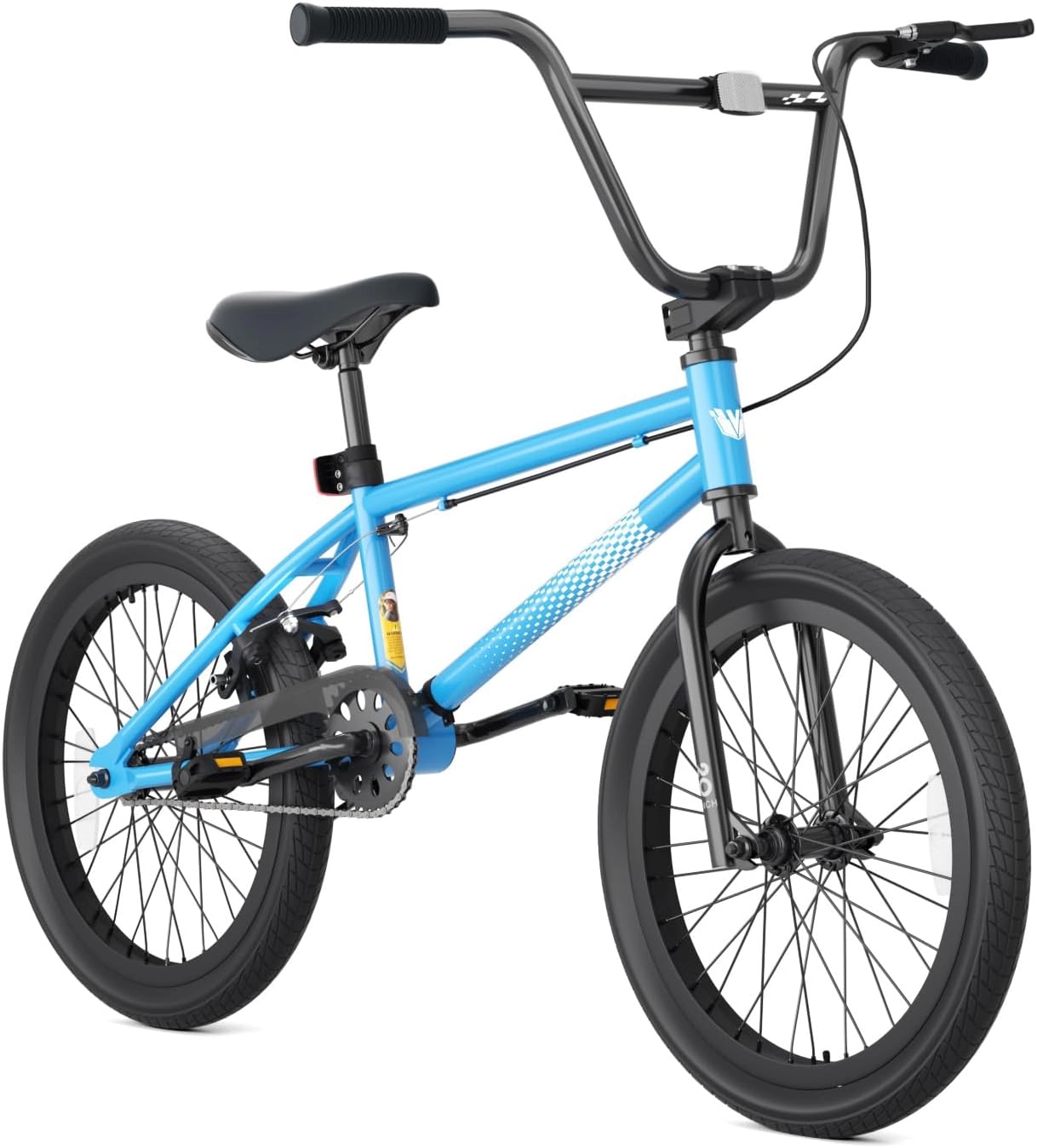 Blue XJD Freestyle BMX Bike, 20-Inch – No Pegs
This kids’ BMX model is relevant as a 20-inch fit candidate for an 8-year-old measuring within the supplied 48–60-inch height range. Its no-pegs label does not establish individual fit.
 XJD Kids Beach Cruiser Bicycle, Rear Rack & V-Brakes, Mint Green
This beach cruiser offers 20 Inch, 24 Inch and 26 Inch labels. For most 8-year-olds, the 20 Inch selection is the relevant comparison; larger selections require their own height-based and hands-on fit checks.
Blue XJD Freestyle BMX Bike, 20-Inch – No Pegs is a kids’ BMX bike whose title identifies a 20-inch wheel size and no pegs. It is relevant when the child measures within the 20-inch starting range, but its BMX category and size label do not replace checks for clearance, reach, braking and confidence.
XJD Kids Beach Cruiser Bicycle, Rear Rack & V-Brakes, Mint Green is a beach-cruiser option offered with 20 Inch, 24 Inch and 26 Inch SKU labels. For this question, compare the 20 Inch selection first when the rider is 48–60 inches tall. The 24 Inch label corresponds to an XBikes starting range of ages 10–14 and heights 54–64 inches, so it should not be chosen for an average 8-year-old simply to allow growth. The 26 Inch selection is intended as a starting point for youth and adults over 60 inches (153 cm), making it unlikely to be relevant to most riders of this age.
Make the final decision
Use a properly fitting bicycle helmet that sits level, with straps adjusted according to its manufacturer’s instructions. Follow the exact bicycle manual for assembly and maintenance, or use a qualified bicycle mechanic where needed.
For an 8-year-old boy, measure height and inseam today, shortlist 18-inch and 20-inch bikes from the ranges above, and have him try them. Select the smallest candidate that provides appropriate clearance while allowing comfortable reach, dependable brake operation and confident starts, turns and stops—never the larger bike solely because he may grow into it.
Bikes for your next adventure
-

Black XJD Kids Bike for Boys – 12, 14 & 16 Inch Sizes
For a son between roughly 3 and 8 years old, the XJD Kids Bike in Black covers t…$169
$199 -

Light Purple XJD Toddler Bike Helmet, Adjustable, Size XS (46–51 cm)
This Light Purple XJD toddler bike helmet is made for the smallest riders — the …$20.39
-

Black XJD Toddler Bike Helmet, Adjustable – Kids' Protective Helmet
The XJD Toddler Bike Helmet in black is an adjustable protective helmet for kids…$20.39