

How do kids learn to ride a bike
Kids learn to ride a bike by mastering balance, steering, braking and pedalling in small, confidence-building steps on a correctly fitted bicycle.
Check fit before teaching
Measure the child’s height and inseam, then have them try the actual bicycle. Age is only a starting point. They need comfortable stand-over clearance, an easy reach to the handlebar and the ability to operate the brakes without stretching or losing control.
Do not choose an oversized bicycle just to allow room for growth. A bike that is difficult to stand over, steer or stop can make learning harder. Use these XBikes starting points, then confirm individual fit:
| Wheel size | Starting age | Rider height |
|---|---|---|
| 12 Inch | 3–4 | 34–40 in / 86–102 cm |
| 14 Inch | 3–6 | 37–45 in / 94–114 cm |
| 16 Inch | 4–7 | 40–48 in / 102–122 cm |
| 18 Inch | 5–9 | 43–52 in / 109–132 cm |
| 20 Inch | 7–12 | 48–60 in / 122–152 cm |
| 24 Inch | 10–14 | 54–64 in / 137–163 cm |
| 26 Inch | Youth and adults | Over 60 in / 153 cm |
If the child falls between starting points, compare both relevant sizes in person. Their measured height, inseam, reach, brake control and present confidence matter more than age alone.
Teach the skills in a useful order
- Walking and stopping: Let the child walk the bike while seated or standing over it. Practise using the brakes and coming to a controlled stop before adding speed.
- Balance and steering: In a level, open area away from traffic, let the child push off, lift their feet briefly and look toward the route ahead. Encourage smooth turns rather than sharp handlebar movements.
- Starting: Ask the child to set a pedal in a strong starting position, push down and look forward. Support the child gently if needed, without pulling the handlebar or steering for them.
- Pedalling and stopping: Once starts are repeatable, combine steady pedalling with planned stops at a visible marker. Short, successful attempts usually build more confidence than continuing after the child becomes tired or frustrated.
Training wheels can help a child become familiar with pedalling, steering and braking, but they do not teach two-wheel balance in the same way. If they are used, keep separate balance practice in the learning plan.
Set up a calm practice space
Choose a flat, predictable surface with generous space and no vehicle traffic, steep slopes or closely packed obstacles. Check the bicycle before each session and follow its exact product manual for assembly, adjustments and maintenance. If anything is loose, damaged or unclear, use a qualified bicycle mechanic rather than guessing at a procedure or torque.
A bicycle helmet should fit properly, sit level and have its straps adjusted according to the helmet manufacturer’s instructions. Clothing and footwear should allow free movement and should not hang near moving parts.
Compare the relevant catalog options
These catalog choices show two distinct learning contexts: a multi-size training-wheel bike for early pedalling practice and a 20-inch kids’ BMX bike for a rider whose fit and skills are ready for that category. They help parents compare wheel-size availability and bike type after measuring the child.
 Blue XJD Freestyle BMX Bike, 20-Inch – No Pegs
A 20-inch Kids’ BMX Bikes option relevant for riders comparing that wheel size after checking height, inseam, reach, brake control and confidence. It is listed without pegs.
 Pink 12/14/16/20" XJD Girls Bike with Training Wheels & Basket
A Training Wheel Bikes option offered in 12, 14, 16 and 20 Inch labels, relevant when comparing supported pedalling practice across measured-fit starting points.
The Pink 12/14/16/20" XJD Girls Bike with Training Wheels & Basket is listed in Training Wheel Bikes and is available in 12 Inch, 14 Inch, 16 Inch and 20 Inch labels. Compare only the size that matches the child’s measurements and successful fit check. Its training-wheel category makes it relevant when the current goal includes supported pedalling practice.
The Blue XJD Freestyle BMX Bike, 20-Inch – No Pegs is a 20-inch option in Kids’ BMX Bikes. The XBikes starting point for 20 Inch is ages 7–12 and heights 48–60 in / 122–152 cm, but that range does not replace checking stand-over clearance, reach and brake control. It is not a substitute when the child needs a smaller wheel size or supported training-wheel practice.
Know when to advance or pause
Move forward when the child can start, steer a chosen line, look ahead and stop on request without an adult holding the bike. Add gentle turns and longer runs gradually. Pause if the child cannot reach the controls, repeatedly tips while stationary, cannot stop predictably or becomes too tense to look ahead.
The next decision is practical: measure height and inseam, compare the appropriate wheel-size starting points, perform an individual fit check, then practise stopping, balancing, starting and pedalling in that order.
Bikes for your next adventure
-

Black XJD Kids Bike for Boys – 12, 14 & 16 Inch Sizes
For a son between roughly 3 and 8 years old, the XJD Kids Bike in Black covers t…$169
$199 -

Blue XJD Girls Bike with Training Wheels – 12/14/16 Inch
If you're shopping for a first pedal bike for a daughter roughly 3 to 8 years ol…$149
$169 -
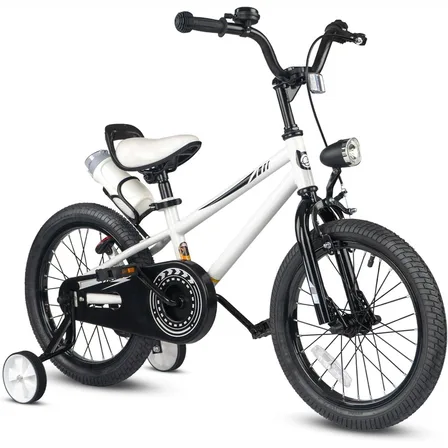
XJD Kids' Training Wheel Bike for Boys & Girls, 12/14/16 Inch – White
The XJD kids' training wheel bike in White is made for riders ages 3–8 (roughly …$169
$199