

What age is an 18 inch bike for
An 18-inch bike is a starting point for many children ages 5–9 who are 43–52 inches (109–132 cm) tall, but measured fit matters more than age.
Who usually fits an 18-inch bike?
Under the XBikes wheel-size starting points, an 18-inch bicycle generally suits a rider aged 5–9 with a height of 43–52 inches (109–132 cm). That range helps narrow the search, but it cannot confirm that a particular frame fits your child.
Children of the same age can have different leg lengths, arm lengths and confidence levels. Before choosing, measure the child and have them try the actual bicycle whenever possible. Do not move up to an oversized bike simply to allow room for growth; a bike that is difficult to stand over, steer or stop is not an appropriate fit today.
What should you measure?
Start with the child’s current height, measured without shoes against a wall. Then measure inseam from the floor to the crotch while the child stands upright with feet slightly apart. Wheel size is only a category: frame shape, saddle adjustment and handlebar position can make two bikes with the same wheel diameter feel different.
Compare the measurements and the child’s ability with these relevant XBikes starting points:
| Wheel size | Starting age | Starting rider height |
|---|---|---|
| 16 Inch | 4–7 | 40–48 in / 102–122 cm |
| 18 Inch | 5–9 | 43–52 in / 109–132 cm |
| 20 Inch | 7–12 | 48–60 in / 122–152 cm |
If the child falls near an overlap, do not decide from the chart alone. Their inseam, reach, control and present riding confidence should determine which actual bike to try first.
How to check an 18-inch bike in person
Have the child wear their usual riding shoes and try the bicycle in a clear, controlled area. An adult should steady it while checking the following:
- Stand-over: The child should be able to straddle the bike without the frame preventing stable contact with the ground.
- Saddle position: With the saddle adjusted within the limits stated in the product manual, the child should be able to start and stop confidently.
- Reach: They should hold the handlebars without stretching, locking their elbows or leaning excessively.
- Steering: They should be able to turn the bars while remaining balanced and in control.
- Brake control: They must comfortably reach and operate the fitted brakes. Check both reach and the force needed to use them.
If any of these checks fail, adjustment may help, but do not exceed the manual’s limits. Follow the exact product manual for assembly, maintenance and compatibility, or ask a qualified bicycle mechanic.
How the supplied bikes help with the comparison
Neither supplied catalog product has an 18-inch option. They are nearest-size comparison points, not substitutes for an 18-inch bicycle: the Pink 12/14/16/20" XJD Girls Bike with Training Wheels & Basket offers 16-inch and 20-inch choices around the requested size, while the 26-Inch XJD Beach Cruiser Bike for Girls – Purple, V-Brake has 20-inch choices among its listed variants. These options help a parent compare the adjacent wheel-size ranges after measuring the rider.
 Pink 12/14/16/20" XJD Girls Bike with Training Wheels & Basket
Offers 16-inch and 20-inch SKUs as adjacent-size comparison points around an 18-inch bike, but neither is an exact substitute. Use the rider’s measurements and an individual fit check.
 26-Inch XJD Beach Cruiser Bike for Girls – Purple, V-Brake
Its 20-inch Mint Green and Pink variants provide a nearby larger-size comparison. The listed 24-inch and 26-inch variants are farther from the requested 18-inch size and should follow their own fit ranges.
When are those catalog options relevant?
The Pink 12/14/16/20" XJD Girls Bike with Training Wheels & Basket is relevant when the fit check indicates that an adjacent size deserves consideration. Its 16-inch label corresponds to the XBikes starting point of ages 4–7 and heights 40–48 inches (102–122 cm); its 20-inch label corresponds to ages 7–12 and heights 48–60 inches (122–152 cm). Neither label makes it equivalent to an 18-inch bike.
The 26-Inch XJD Beach Cruiser Bike for Girls – Purple, V-Brake lists Mint Green and Pink variants in 20-inch, 24-inch and 26-inch sizes, plus Purple in 26-inch. For this question, only its 20-inch variants are a nearby comparison. Under the XBikes standard, 24 inches starts at ages 10–14 and 54–64 inches (137–163 cm), while 26 inches is for youth and adults over 60 inches (153 cm); those are not direct 18-inch alternatives.
If the child measures below 43 inches (109 cm), begin the fit comparison with a smaller size rather than assuming 18 inches. If the child is at least 48 inches (122 cm), an 18-inch and a 20-inch bike may both appear in the height overlap, but only an individual trial can settle the choice. A nervous or developing rider may also need a different fit from a confident rider of the same height.
Make the final decision
Choose an 18-inch bike only if the child falls near the 43–52-inch (109–132 cm) starting range and can stand over, reach, steer and operate the brakes confidently on that specific bicycle. Fit a bicycle helmet so it sits level and its straps follow the helmet manufacturer’s instructions. If the 18-inch fit check fails, compare the child’s measurements with the adjacent 16-inch or 20-inch range and test that exact bike rather than guessing from age.
Bikes for your next adventure
-
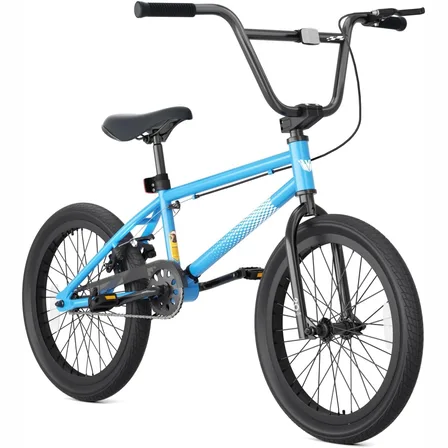
Blue XJD Freestyle BMX Bike, 20-Inch – No Pegs
The XJD 20-Inch Blue Freestyle BMX is an entry-level BMX bike for boys and girls…$189.99
-

26-Inch XJD Beach Cruiser Bike for Girls – Purple, V-Brake
This XJD 26-inch purple beach cruiser is sized for big kids and teens — suggeste…$218.49
$229.99 -
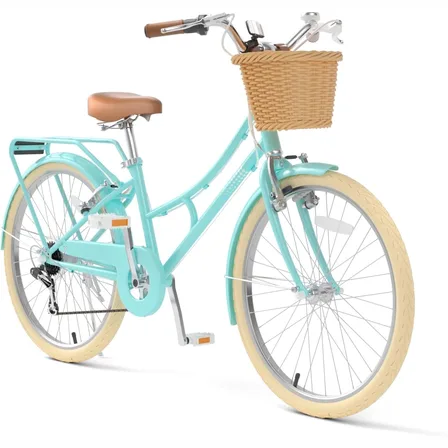
XJD Kids Beach Cruiser Bicycle, Rear Rack & V-Brakes, Mint Green
The XJD Beach Cruiser in Mint Green is a geared, multi-speed cruiser bike for ol…$179.99
$209.99