

When can a baby sit in a bike seat
A baby can usually sit in a bicycle passenger seat at about 12 months, but only after sitting upright unsupported and holding a helmeted head steady.
Readiness matters more than the birthday
Do not use age alone as the decision. A baby needs enough neck and trunk control to remain stable while the bicycle starts, stops, turns and passes over ordinary bumps. The child should sit independently without being propped up and should not slump sideways or let the head fall forward while wearing a properly fitted bicycle helmet.
Babies younger than about 12 months generally lack the neck strength needed for bicycle transport. Even after that point, wait if your child was born prematurely, has delayed motor development, cannot tolerate the helmet or cannot stay upright throughout a practice fitting. Ask the child’s pediatric clinician when development or health makes readiness uncertain.
Check the seat, bicycle and local rules
Developmental readiness is only one requirement. Read the exact passenger-seat manual for its minimum age, permitted child size, load limit, harness adjustment and bicycle compatibility. Local laws may impose a different minimum age or helmet requirement. Follow whichever applicable requirement is stricter.
Confirm that the bicycle and mounting location are explicitly compatible with the seat. Use every supplied restraint and foot-retention feature exactly as directed. For mounting hardware, assembly, compatibility or torque information not stated in the manual, use a qualified bicycle mechanic rather than improvising.
Make a seated fit check before riding
Place the stationary bicycle on level ground and have another adult stabilize it. With the baby secured according to the seat instructions, check these points:
- The back and bottom remain in the intended seated position.
- The harness lies correctly and cannot be slipped off.
- The helmet stays level rather than tipping forward or backward.
- The baby can hold the helmeted head steady without slumping.
- Feet, clothing and straps cannot reach wheels or other moving parts.
- The rider can mount, balance, steer and stop while accounting for the added passenger load.
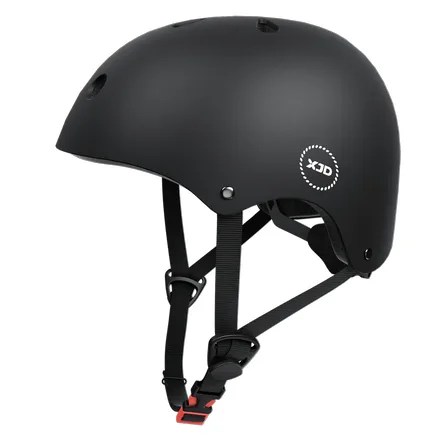
A bicycle helmet must fit properly, sit level and have its straps adjusted according to its manufacturer’s instructions. A helmet that shifts, obstructs vision or forces the baby’s head into an unstable position means the setup is not ready.
Take the first ride in small steps
- Practice mounting, balancing and braking with the seat installed but no passenger.
- Repeat the full restraint and helmet check with the bicycle stationary.
- Begin with a very short ride in a flat, traffic-free area.
- Stop immediately if the baby slumps, becomes distressed or cannot keep the head steady.
- Recheck the mount, restraints and helmet before every later ride.
A child who sleeps may lose active head control, so do not treat a successful awake fitting as proof that every ride length or condition is suitable. Avoid carrying extra objects that interfere with control, and never leave a baby unattended in a bicycle seat.
Why the listed XBikes products are different
The supplied products are children’s training-wheel bicycles with doll seats, not verified bicycle passenger seats for carrying a baby. They help distinguish a decorative doll-seat feature from equipment designed and documented for a real child passenger.
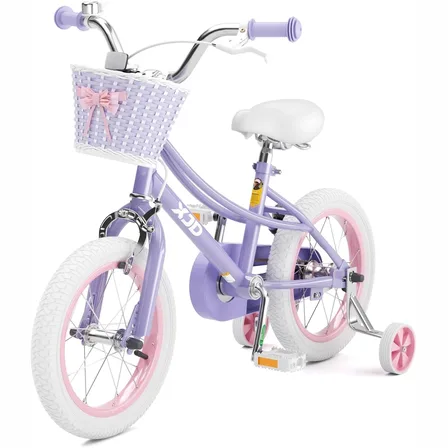
 Purple XJD Girls' Bike with Doll Seat & Basket
A training-wheel bicycle offered in 12, 14 and 16 Inch sizes. Its supplied feature is a doll seat, so it is relevant only for distinguishing a toy-carrying feature from a baby passenger seat.
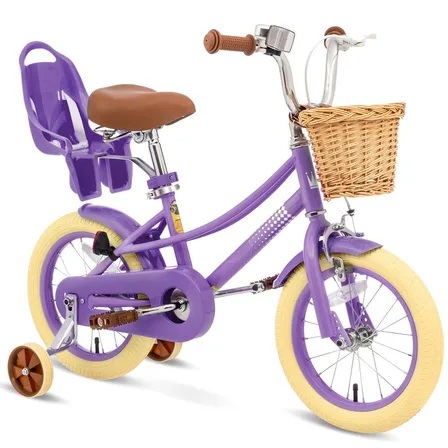
 Pink Girls' 12/14/16" Bike by XJD – Basket & Doll Seat
Available in supplied 12, 14 and 16 Inch choices with a basket and doll seat. The doll seat is not a verified child-passenger seat; consider the bicycle only later for an individually fitted rider.
Purple XJD Girls' Bike with Doll Seat & Basket is listed in 12 Inch, 14 Inch and 16 Inch sizes. Pink Girls' 12/14/16" Bike by XJD – Basket & Doll Seat has the same supplied size choices. Their doll seats must not be treated as baby seats or used to carry a child.
These bicycles become relevant later, when the child is choosing a bicycle to ride rather than riding as a passenger. XBikes uses these starting points: 12 Inch for ages 3–4 and heights 34–40 in / 86–102 cm; 14 Inch for ages 3–6 and 37–45 in / 94–114 cm; and 16 Inch for ages 4–7 and 40–48 in / 102–122 cm.
Those ranges are comparison points, not proof of fit. Measure the rider’s standing height and inseam, then have the child try the bicycle. Check stand-over clearance, reach, brake control and current confidence. Do not buy an oversized bicycle merely for growth. Where size ranges overlap, the individual fit check decides—not age, color or the presence of a basket or doll seat.
The decision to make now
Use a bicycle passenger seat only when your baby is around 12 months or older, sits unsupported, controls the helmeted head, meets the seat manual and local requirements, and passes a stationary fit check. If any one of those conditions fails, wait. The two listed XBikes models are later-stage riding options for appropriately fitted children; their doll seats are never substitutes for an approved baby-passenger setup.
Bikes for your next adventure
-
Girls' Training Wheel Bike by XJD with Basket – Purple
If you're shopping for a first bike for a girl roughly 3 to 12 years old (91–152…$75.99
-
7-in-1 Kids Helmet & Protective Gear Set from XJD – Black or Blue
If you're outfitting one kid (or a couple of siblings) for biking, scootering, o…$59.99
-
XJD Girls' Bike with Training Wheels, 12/14/16/20 Inch – Purple
The XJD girls' bike with training wheels in Purple is built to grow with your ri…$139
$159