

When can baby use bike seat
A baby can use a child bike seat only after sitting upright unsupported, maintaining steady head and neck control while wearing a helmet, and meeting every limit in the seat’s manual. Age alone is not enough.
Check readiness before planning a ride
Watch the child sit on a firm, level surface without being held. They should remain upright and control their head consistently, rather than slumping or needing support. Repeat the observation while they wear their properly fitted bicycle helmet because its weight can affect head control.
If readiness is uncertain, ask the child’s pediatrician before riding. A premature birth, low muscle tone, delayed development or another medical consideration can make an age-based assumption especially unreliable.
Measure and compare the right details
Measure the baby’s current weight and height, then compare both figures with the child-seat manufacturer’s stated minimum and maximum limits. Also check any developmental requirement in the manual. Do not round up, anticipate growth or treat a different model’s limits as interchangeable.
Next, compare the seat’s compatibility instructions with the exact bicycle and mounting location. Frame design, rack requirements and permitted mounting arrangements vary. The supplied catalog facts do not establish child-seat compatibility or load capacity for any bicycle on this page. Follow the manuals for both products or ask a qualified bicycle mechanic to confirm the installation.
Confirm the seated fit
Once the child is developmentally ready and within the stated limits, perform the manual’s fit checks before every ride. Confirm that the restraint is routed and adjusted as directed, feet are contained in the intended supports, and clothing or straps cannot reach moving parts. The child should remain upright without the restraint being used to compensate for poor head or torso control.
A bicycle helmet must fit properly, sit level and have its straps adjusted according to the helmet manufacturer’s instructions. Replace guesswork with the specific guidance supplied with the helmet and child seat.
What the listed XBikes products can—and cannot—tell you
The three catalog options below are complete children’s bicycles, not baby passenger seats. They therefore do not answer child-seat mounting or infant load-limit questions. They are useful only as future rider-size comparison points: the Black XJD Kids' BMX Bicycle with Training Wheels offers 12 Inch, 14 Inch and 16 Inch labels; the Blue XJD Freestyle BMX Bike, 20-Inch – No Pegs is a 20-inch option; and the 24-Inch Purple XJD Beach Cruiser Bike with U-Brake is a 24-inch option.
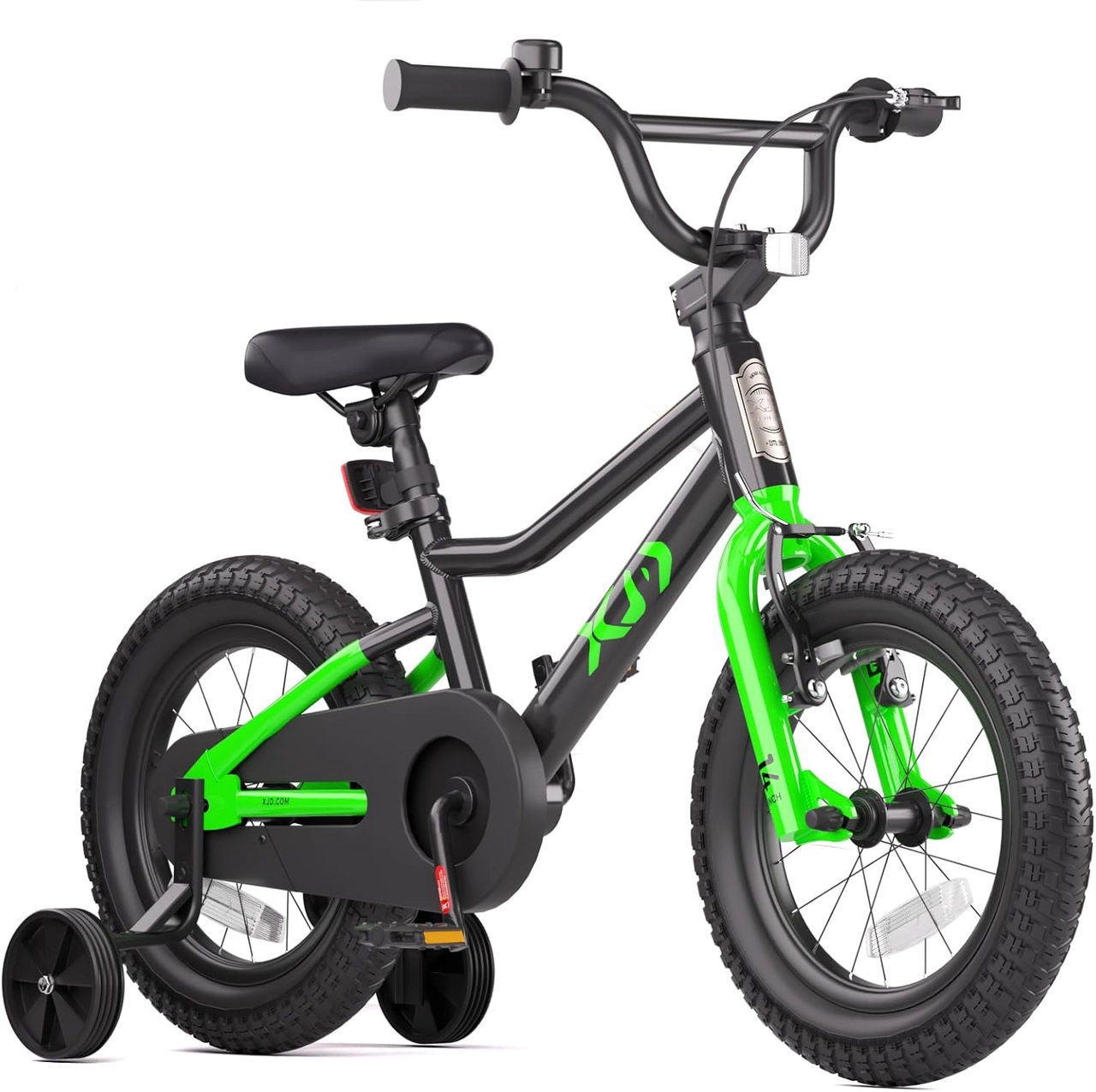 Black XJD Kids' BMX Bicycle with Training Wheels
A future independent-riding comparison with 12 Inch, 14 Inch and 16 Inch choices. It is a children’s BMX bicycle with training wheels, not a baby passenger seat, and its size labels do not establish child-seat compatibility.
 24-Inch Purple XJD Beach Cruiser Bike with U-Brake
This 24-inch beach cruiser is a later rider-size comparison point, using the XBikes starting range of ages 10–14 and heights 54–64 inches. It is not a baby seat and does not establish mounting compatibility.
 Blue XJD Freestyle BMX Bike, 20-Inch – No Pegs
This 20-inch kids’ BMX bicycle is relevant only for later independent riding, with an XBikes starting point of ages 7–12 and heights 48–60 inches. It is not a baby passenger seat.
These wheel sizes are not substitutes for a baby seat, and a larger size is not equivalent to a smaller one. When a child later progresses to riding independently, use measured fit rather than choosing a bicycle for growth.
Use wheel size only when the child becomes a rider
| Catalog comparison | XBikes starting point |
|---|---|
| 12 Inch | Ages 3–4; height 34–40 in / 86–102 cm |
| 14 Inch | Ages 3–6; height 37–45 in / 94–114 cm |
| 16 Inch | Ages 4–7; height 40–48 in / 102–122 cm |
| 20 Inch | Ages 7–12; height 48–60 in / 122–152 cm |
| 24 Inch | Ages 10–14; height 54–64 in / 137–163 cm |
These figures are starting points, not proof of fit. Have the child try the bicycle. Check measured height and inseam, stand-over clearance, reach, ability to control the bicycle, access to its brakes and present confidence. Do not buy an oversized bicycle merely to allow room for growth.
Make a go, wait or stop decision
- Go: the baby sits unsupported, controls their head and neck while helmeted, falls within every manufacturer limit, fits the restraint correctly, and the manuals confirm bicycle and seat compatibility.
- Wait: the baby slumps, needs sitting support, cannot manage the helmet steadily, or has not yet reached any stated minimum.
- Stop and verify: a limit, mounting requirement, restraint fit or compatibility detail is missing or unclear. Consult the exact manuals or a qualified bicycle mechanic rather than improvising.
The practical next step is to observe unsupported sitting, measure current height and weight, and check those results against the exact child-seat manual. If all three checks do not clearly agree, postpone the bike-seat ride.
Bikes for your next adventure
-

Kids Bike Helmet by XJD for Boys & Girls – Black, Blue, Green, Pink, Purple
The XJD Kids Bike Helmet covers a wide 2-to-8-year age range thanks to two head-…$59.99
-

Kids Bike Helmet by XJD for Girls – Pink
The XJD Kids Bike Helmet in Pink is a lightweight multi-sport helmet for girls r…$59.99
$99 -

XJD Kids Bike for Girls – Pink, 12/14/16/20 Inch with Training Wheels
The XJD Kids Bike for Girls in Pink is a training-wheel bike built to carry your…$139
$159