

When children ready for first bike
A child is ready for a first bike when the bike fits now and the child can balance, steer, stop and follow simple directions with confidence.
Check readiness before choosing a wheel size
Age is only a starting point. Watch what your child can do: walk or run steadily, climb on and off with little help, look ahead while moving, steer around an object and stop when asked. They should also be willing to practise; fear or persistent resistance is a reason to wait rather than push.
Before buying, have the child try the bicycle. A first bike should not be oversized for future growth. The rider needs enough clearance when standing over it, a comfortable reach to the handlebar and reliable access to every brake control. They should be able to start, turn and stop without stretching, twisting or losing control.
Measure height and inseam
Measure the child without shoes, standing straight against a wall. Record total height from floor to head. For inseam, place a book firmly between the legs to imitate a saddle, keep it level and measure from the floor to the top edge.
Compare those measurements with the bicycle's stand-over clearance and saddle adjustment information. Height helps identify a starting wheel size; inseam helps determine whether the child can stand over and manage the actual frame. Frame shapes differ, so matching a chart does not replace sitting on and trying the specific bicycle.
Use wheel size as a starting point
| Wheel size | Starting age | Rider height |
|---|---|---|
| 12 Inch | 3–4 | 34–40 in / 86–102 cm |
| 14 Inch | 3–6 | 37–45 in / 94–114 cm |
| 16 Inch | 4–7 | 40–48 in / 102–122 cm |
| 18 Inch | 5–9 | 43–52 in / 109–132 cm |
| 20 Inch | 7–12 | 48–60 in / 122–152 cm |
| 24 Inch | 10–14 | 54–64 in / 137–163 cm |
| 26 Inch | Youth and adults | Over 60 in / 153 cm |
When ranges overlap, choose by measured fit, reach, brake control and current confidence—not by age or the larger wheel. If the child fits two possible sizes, compare both in person. The suitable one is the bike they can control comfortably now.
Compare the supplied XBikes options
These catalog options make the decision more concrete because they cover several starting sizes and different bicycle categories. Use them only after measuring the rider, then compare the available wheel labels with the child's fit check.
 XJD Light Purple Girls Bike with Basket, Training Wheels, 12/14/16/20 Inch
A Training Wheel Bikes option available in 12 Inch, 14 Inch and 16 Inch labels, relevant for measured riders comparing smaller first-bike starting sizes.
 XJD Kids Beach Cruiser Bicycle, Rear Rack & V-Brakes, Mint Green
A Beach Cruiser Bikes option available in 20 Inch, 24 Inch and 26 Inch labels, potentially relevant for a taller or older first-time rider after an individual fit check.
 XJD Girls BMX Bike 12/14/16 Inch with Training Wheels – Pink Blue
A Kids' BMX Bikes option with training wheels, available in 12 Inch, 14 Inch and 16 Inch labels for comparison after measuring the rider.
The XJD Light Purple Girls Bike with Basket, Training Wheels, 12/14/16/20 Inch is listed in Training Wheel Bikes, with available 12 Inch, 14 Inch and 16 Inch options. It is relevant when the measured rider falls near one of those starting ranges and needs to compare a training-wheel model.
The XJD Girls BMX Bike 12/14/16 Inch with Training Wheels – Pink Blue is listed in Kids' BMX Bikes and likewise has available 12 Inch, 14 Inch and 16 Inch options. Compare its actual stand-over clearance, reach and brake access with the rider rather than treating the sizes as interchangeable.
The XJD Kids Beach Cruiser Bicycle, Rear Rack & V-Brakes, Mint Green is listed in Beach Cruiser Bikes with available 20 Inch, 24 Inch and 26 Inch options. Those sizes begin at taller rider ranges, so this model may be relevant to an older or taller first-time rider, but not as a substitute for a smaller correctly fitting bike.
None of these supplied products offers an 18 Inch option. If measurement points to 18 Inch, the listed 16 Inch and 20 Inch products are nearest-size comparison points only; neither is an equivalent replacement. Find and fit-check the required size.
Make the trial ride decisive
- Confirm the child can mount and dismount without being caught by the frame.
- Check that their hands reach the grips and every brake control comfortably.
- Ask them to look forward, start, steer a simple path and stop on command.
- Notice whether the bicycle feels manageable rather than heavy, intimidating or difficult to turn.
- Repeat the comparison if posture is cramped, reach is stretched or stopping is uncertain.
Training wheels may support early pedalling confidence, but their presence does not correct poor frame fit or prove readiness. Follow the exact product manual for assembly, adjustment, maintenance, compatibility and load limits. If anything is unclear, use a qualified bicycle mechanic.
Prepare for the first ride
Choose a flat, open area away from traffic and obstacles. Keep the first sessions short and calm, with close adult supervision. A bicycle helmet must fit properly, sit level and have its straps adjusted according to the helmet manufacturer's instructions.
The next step is simple: measure height and inseam, shortlist the matching wheel range, and let the child demonstrate comfortable stand-over, reach, steering and stopping. Buy only when the specific bike fits today and the child is ready to control it.
Bikes for your next adventure
-

XJD Kids Bike for Girls – Pink, 12/14/16/20 Inch with Training Wheels
The XJD Kids Bike for Girls in Pink is a training-wheel bike built to carry your…$139
$159 -

Blue XJD Girls Bike with Training Wheels – 12/14/16 Inch
If you're shopping for a first pedal bike for a daughter roughly 3 to 8 years ol…$149
$169 -
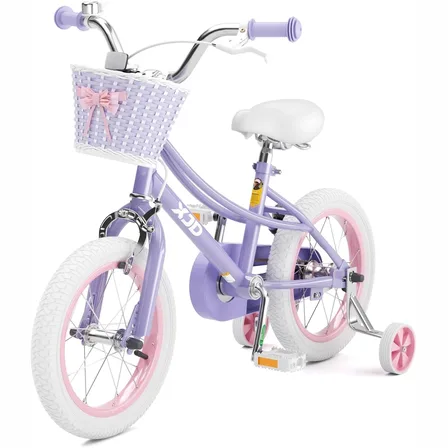
Girls' Training Wheel Bike by XJD with Basket – Purple
If you're shopping for a first bike for a girl roughly 3 to 12 years old (91–152…$75.99