

What is the difference between a boys and girls bike
Boys’ and girls’ bikes are usually separated by colour, graphics or frame styling—not by a different sizing system. Choose by the child’s measured fit, control and confidence rather than the gender label.
What is the practical difference?
A bike marketed for boys may use different colours, graphics or frame shapes from one marketed for girls. Those labels do not tell you whether the bicycle fits a particular child. Wheel size, usable stand-over clearance, reach to the handlebar and access to the brakes matter more.
Some designs may have a lower or differently shaped top tube, which can make mounting and standing over the frame easier. That feature is useful for any rider who benefits from it; it is not inherently limited to girls. Compare the actual frames in person instead of assuming that two bikes with the same wheel size will feel identical.
Measure the rider before comparing labels
Measure the child’s height without shoes, then measure the inseam from the floor to the crotch. Use height to identify a starting wheel size and inseam to assess stand-over fit. Age is only a rough guide.
Have the child try the bicycle. When standing over it, the child should have appropriate clearance rather than being pressed against the frame. While seated, the rider should reach the handlebar without stretching, steer comfortably and operate the brakes with control. Do not buy an oversized bicycle solely to allow room for growth.
XBikes wheel-size starting points
| Wheel size | Starting age | Rider height |
|---|---|---|
| 12 Inch | 3–4 | 34–40 in / 86–102 cm |
| 14 Inch | 3–6 | 37–45 in / 94–114 cm |
| 16 Inch | 4–7 | 40–48 in / 102–122 cm |
| 18 Inch | 5–9 | 43–52 in / 109–132 cm |
| 20 Inch | 7–12 | 48–60 in / 122–152 cm |
| 24 Inch | 10–14 | 54–64 in / 137–163 cm |
| 26 Inch | Youth and adults | Over 60 in / 153 cm |
These overlapping ranges are starting points, not guarantees. If a child falls into two rows, compare both sizes through an individual fit check. Prioritize measured height and inseam, comfortable reach, reliable brake control and present confidence over age or a boys’ or girls’ designation.
How to compare two bikes in the shop
- Confirm the wheel-size candidates. Begin with the measured-height range, then reject any bicycle that is clearly too large or small during the fit check.
- Check stand-over and mounting. Ask the child to get on and off without assistance and stand over the frame comfortably.
- Check the riding position. The child should hold the handlebar and turn it without leaning or stretching excessively.
- Check the controls. Make sure the child can reach and operate the brakes confidently from the normal riding position.
- Compare confidence. Let the child start, stop and turn in a suitable controlled area. A style preference is a reasonable final choice only after both options fit.
If assembly, adjustment, load limits, compatibility, maintenance or torque information is needed, follow the exact product manual or consult a qualified bicycle mechanic rather than guessing.
How the supplied bikes relate to this question
The two catalog options are relevant because both exact titles explicitly include boys and girls, demonstrating that a single model can be presented for either. The XJD Kids' Training Wheel Bike for Boys & Girls, 12/14/16 Inch – White is categorized as a Training Wheel Bike, while the XJD Boys & Girls BMX Bike with Training Wheels, 12/14/16" – Blue is categorized as a Kids' BMX Bike. Each has supplied 12 Inch, 14 Inch and 16 Inch SKU labels, so compare the appropriate listed size and category rather than treating colour or gender wording as fit evidence.
 XJD Kids' Training Wheel Bike for Boys & Girls, 12/14/16 Inch – White
A Training Wheel Bike offered with 12 Inch, 14 Inch and 16 Inch SKU labels; its exact title includes boys and girls, making it relevant when fit—not gender wording—selects one of those sizes.
 XJD Boys & Girls BMX Bike with Training Wheels, 12/14/16" – Blue
A Kids' BMX Bike with training wheels offered in 12 Inch, 14 Inch and 16 Inch SKU labels. Its boys-and-girls title supports comparing category, size and individual fit instead of relying on gender labels.
These products are relevant only when a 12, 14 or 16 Inch starting point matches the rider and the individual fit check succeeds. They are not substitutes for an 18, 20, 24 or 26 Inch bike; for a rider needing one of those sizes, use them only as smaller-size comparison points.
Make the final boys-versus-girls decision
First choose the wheel-size candidates from measured height, then verify inseam clearance, reach, brake operation and confidence on each actual bicycle. After those checks, let the child choose the frame styling or colour they prefer. Also fit a bicycle helmet so it sits level and secure, with its straps adjusted according to the helmet manufacturer’s instructions. The right decision is the bike the child can control now—not the one whose gender label seems to match.
Bikes for your next adventure
-

Black XJD Toddler Bike Helmet, Adjustable – Kids' Protective Helmet
The XJD Toddler Bike Helmet in black is an adjustable protective helmet for kids…$20.39
-

Light Pink XJD Girls' Bicycle with Basket & Training Wheels
The Light Pink XJD Girls' Bicycle with Basket & Training Wheels is a retro-style…$109.99
$129.99 -
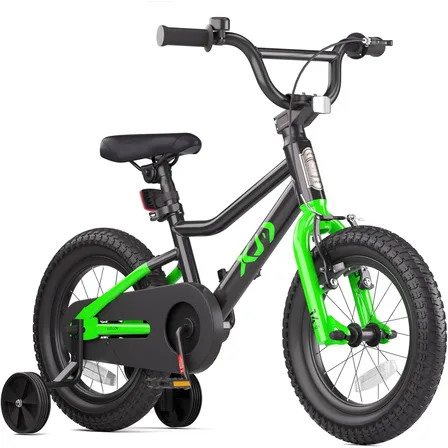
Black XJD Kids' BMX Bicycle with Training Wheels
The XJD Kids' BMX Bicycle with Training Wheels is built for children roughly 3 t…$99.99
$119.99