

Why do they still make girls bikes
They still make “girls’ bikes” mainly as a shopping and styling category—not because girls need a fundamentally different kind of bicycle. Fit, control and confidence matter more than the gender label.
What the label actually tells you
A “girls’ bike” label may help families find certain colors, graphics or frame shapes, but it is not a reliable fit specification. Those details vary among models, and a child can ride any appropriately sized bicycle that feels comfortable and controllable.
Treat “girls,” “boys” and “unisex” as catalog descriptions. Compare the actual wheel size and the child’s fit instead of assuming one label suits her body, ability or preferences better.
Measure before choosing a wheel size
Measure the child’s standing height and inseam while she wears the shoes normally used for riding. Height provides a wheel-size starting point; inseam helps you evaluate stand-over clearance. Age is only a rough secondary clue.
| Wheel size | XBikes starting age | Rider height |
|---|---|---|
| 12 Inch | Ages 3–4 | 34–40 in / 86–102 cm |
| 14 Inch | Ages 3–6 | 37–45 in / 94–114 cm |
| 16 Inch | Ages 4–7 | 40–48 in / 102–122 cm |
The ranges overlap deliberately because children with the same height can differ in leg length, reach and confidence. Do not select from age alone, and do not move up merely because a child will eventually grow into the bicycle.
Check the individual bicycle in person
Have the child try the bicycle whenever possible. The American Academy of Pediatrics advises against buying an oversized bicycle for growth and recommends checking stand-over, control and brake reach.
During the fit check, confirm that she can:
- straddle the frame with usable clearance rather than feeling trapped by it;
- reach the handlebar without stretching or becoming cramped;
- steer while keeping a stable, comfortable riding position;
- reach and operate the bicycle’s braking controls, where fitted; and
- start, stop and turn with confidence appropriate to her current ability.
If she cannot perform those actions comfortably, the bicycle is not the right fit even when its age label or styling appears suitable. Compare the next appropriate size or a different frame rather than trying to compensate for an oversized bicycle.
How the supplied XBikes option relates
The XJD Boys & Girls BMX Bike with Training Wheels, 12/14/16" – Blue is useful here because its catalog title explicitly includes both boys and girls, illustrating that the same bicycle model can be presented for either. Its available SKU labels—12 Inch, 14 Inch and 16 Inch—also let you compare three nearby wheel-size starting points against the child’s measured height. These labels do not replace an individual fit check.

This product is relevant only if one of those three wheel sizes matches the rider’s measurements, reach, brake control and confidence after a proper trial. If the child needs 18 Inch, 20 Inch, 24 Inch or 26 Inch under the XBikes starting points, this product is not an equivalent substitute because those sizes are not among its supplied SKU labels.
The words “Boys & Girls” in the exact product title are a catalog label, not evidence that every child will fit it. Likewise, the supplied facts do not establish its weight, frame material, brake type, load limit, compatibility, certification or suitability for a particular riding environment.
Do the practical checks before riding
Let the child choose styling after narrowing the options to bicycles that physically fit. Preference matters because a bicycle she likes may encourage riding, but appearance should break a tie between suitable choices—not override poor control or reach.
Use a properly fitting bicycle helmet. U.S. Consumer Product Safety Commission guidance says the helmet should sit level and its straps should be adjusted according to the helmet manufacturer’s instructions. For bicycle assembly, adjustments, maintenance, compatibility, load limits or torque, follow the exact product manual or ask a qualified bicycle mechanic; do not guess.
The decision behind the title
Girls’ bikes still exist because gendered categories remain a familiar way to organize and market children’s styles. You do not need to restrict your daughter to that aisle. Measure her height and inseam, identify a starting wheel size, test stand-over and reach, verify brake control, and watch her start and stop. Choose the bicycle she prefers only from the options she can already control—not one labeled for her gender or bought oversized for later.
Bikes for your next adventure
-
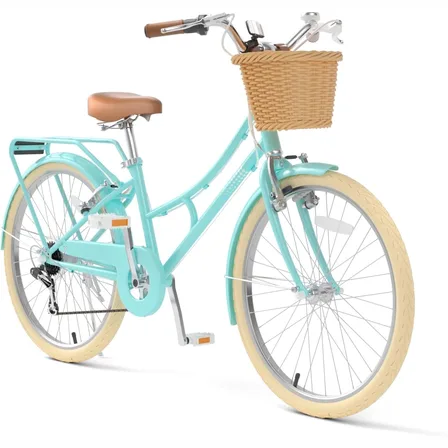
XJD Kids Beach Cruiser Bicycle, Rear Rack & V-Brakes, Mint Green
The XJD Beach Cruiser in Mint Green is a geared, multi-speed cruiser bike for ol…$179.99
$209.99 -
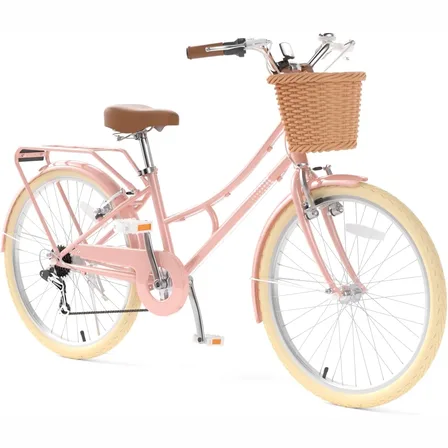
XJD Pink Beach Cruiser for Girls – Rear Rack & V-Brake
The XJD Pink Beach Cruiser for girls is the step-up bike for riders who've outgr…$179.99
$209.99 -
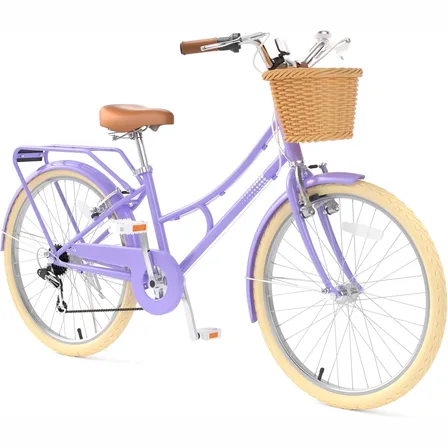
24-Inch Purple XJD Beach Cruiser Bike with U-Brake
The XJD 24-Inch Purple Beach Cruiser is built for girls and young women roughly …$159.99