

What age can a baby ride on a bike seat
A baby can ride in a bicycle child seat only after they can sit upright unsupported, control their head consistently, and meet the seat maker’s limits. Age alone is not enough.
Use readiness, not a birthday, as the deciding test
There is no universal birthday that makes every baby ready for a bike seat. Before riding, confirm that the child can remain upright without being propped up and can keep their head stable while wearing a properly fitted bicycle helmet. A younger infant who slumps, tires quickly, or cannot support the helmet is not ready.
Next, read the exact child-seat manual. Compare its minimum age, minimum and maximum body measurements, load limit, harness instructions, and permitted mounting locations with your child and bicycle. Follow local passenger laws as well, because requirements can differ by location. If the manual gives an age threshold, treat it as a minimum condition rather than proof of readiness.
If you are unsure about head, neck, or sitting control—especially for a premature baby or a child with a medical or developmental concern—ask the child’s healthcare professional before riding.
What to measure and compare
Do not rely on an age estimate or clothing size. Check the child and the proposed setup directly:
- Posture: The child can sit upright unsupported for the expected ride and does not slump inside the seat.
- Head control: The child holds their head steady while wearing the helmet.
- Seat limits: The child falls within every age, body-size, and load requirement printed in the exact seat manual.
- Harness fit: The restraint and foot-retention system can be adjusted as the manufacturer directs, without bulky clothing interfering.
- Bicycle compatibility: The bicycle, rack or frame mounting point, and child seat are explicitly compatible according to their manuals.
- Adult control: The adult rider can start, steer, brake, stop, and support the loaded bicycle confidently.
If any item is uncertain or fails, postpone the ride. A qualified bicycle mechanic should confirm installation and compatibility when the documentation is unclear. Use the product manual for assembly, maintenance, load limits, compatibility, and torque; do not guess at any of them.
Helmet and first-ride checks
A bicycle helmet must fit the child properly, sit level, and have its straps adjusted according to the helmet manufacturer’s instructions. A helmet that pushes the baby’s head forward, shifts out of position, or cannot be secured correctly means the setup is not ready.
Before carrying the child, inspect the seat attachment, harness, foot restraints, wheels, and brakes as directed by the relevant manuals. Practice mounting, balancing, starting, braking, and dismounting the bicycle without the child. For the first passenger ride, choose a short, low-traffic route and stop immediately if the child slumps, becomes distressed, or cannot keep their head stable.
How the supplied bicycle relates to this question
The supplied catalog item is a complete 24-inch bicycle, not a baby bicycle seat. It helps show the difference between carrying a baby as a passenger and fitting an older child to a bicycle they will ride independently. It cannot establish whether a baby seat will mount correctly; only the seat and bicycle manuals, or a qualified mechanic, can do that.
The 24-Inch Purple XJD Beach Cruiser Bike with U-Brake is categorized as a Beach Cruiser Bike and is available with the SKU label Default. Under XBikes’ wheel-size starting points, a 24-inch bicycle corresponds to ages 10–14 and rider heights of 54–64 inches (137–163 cm), subject to an individual fit check. It is therefore an older-rider comparison point, not a substitute for a bicycle child seat and not evidence that a baby can ride as a passenger.

Do not confuse passenger readiness with independent bike fit
When a child eventually rides their own bicycle, wheel-size age bands are only starting points. Measure standing height and inseam, then have the child try the bicycle. Check stand-over clearance, reach, brake access, balance, control, and current confidence. Do not buy an oversized bicycle merely to allow room for growth.
For the supplied 24-inch model, the relevant starting point remains 54–64 inches (137–163 cm) and ages 10–14. Measured fit and control take priority over age. That independent-riding guidance does not provide a minimum age for riding in a passenger seat.
Your next decision
- Confirm that the baby sits unsupported and maintains steady head control while wearing a correctly fitted helmet.
- Compare the child’s measurements and development with every requirement in the exact seat manual.
- Verify that the seat is approved for the specific bicycle and mounting position.
- Follow local passenger rules and have a qualified mechanic check any uncertain installation detail.
If all four checks pass, begin with a short, controlled ride. If even one does not, wait rather than using age alone to justify placing the baby in the bike seat.
Bikes for your next adventure
-

Black XJD Toddler Bike Helmet, Adjustable – Kids' Protective Helmet
The XJD Toddler Bike Helmet in black is an adjustable protective helmet for kids…$20.39
-

Kids Bike Helmet by XJD for Girls – Pink
The XJD Kids Bike Helmet in Pink is a lightweight multi-sport helmet for girls r…$59.99
$99 -
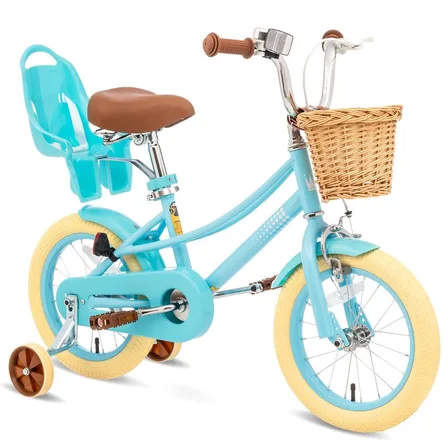
Girls' Training Wheel Bike by XJD, 12–20 Inch Wheels – Blue
This XJD girls' training wheel bike in Blue covers one of the widest fit ranges …$139
$159