

What age can a baby ride on a bike
A baby should not ride a bicycle independently. XBikes sizing starts at about age 3, but measured height, physical control and an individual fit check matter more than age.
Baby passenger or independent rider?
The word ride can mean two different things. If you mean riding as a passenger in a child seat, trailer or cargo-bike system, there is no single age that can be safely inferred from a bicycle wheel-size chart. The child must meet every developmental, size and weight requirement in the exact carrier and bicycle manuals. Confirm compatibility before use; if any instruction is unclear, ask a qualified bicycle mechanic and the child’s healthcare professional.
If you mean controlling a bicycle independently, the supplied XBikes guide begins with 12-inch bicycles at ages 3–4 and rider heights of 34–40 inches (86–102 cm). That is a starting point, not permission based on a birthday. A child also needs enough balance, coordination, reach and confidence to control the particular bicycle.
Measure before comparing ages
Measure the child’s standing height without shoes. Also measure inseam from the floor to the crotch while the child stands naturally. The guide below uses height and age to identify a wheel-size starting point, but it cannot establish stand-over clearance or reach because bicycle geometry varies.
| Wheel size | Age starting point | Rider height |
|---|---|---|
| 12 Inch | 3–4 | 34–40 in / 86–102 cm |
| 14 Inch | 3–6 | 37–45 in / 94–114 cm |
| 16 Inch | 4–7 | 40–48 in / 102–122 cm |
| 18 Inch | 5–9 | 43–52 in / 109–132 cm |
| 20 Inch | 7–12 | 48–60 in / 122–152 cm |
| 24 Inch | 10–14 | 54–64 in / 137–163 cm |
| 26 Inch | Youth and adults | Over 60 in / 153 cm |
Where ranges overlap, do not choose by age alone. Compare the measured height first, then test the actual bicycle. Do not move up to an oversized bicycle merely to leave room for growth.
What the fit check must prove
Have the child try the bicycle rather than deciding from its wheel label. Check whether the child can:
- stand over the bicycle with appropriate clearance rather than being pressed against the frame;
- sit in a stable position and reach the handlebar without stretching or losing posture;
- turn the handlebar while remaining balanced and in control;
- reach and operate the brakes reliably with their hands in a natural position; and
- start, stop and put a foot down without panic or assistance.
If any of these checks fail, the bicycle is not a suitable fit now, even when the child falls within its age range. Current confidence matters too: a reluctant or unsteady rider may need more practice in a controlled area before moving to a larger bicycle.
How the supplied bicycles relate
These catalog options provide concrete wheel-size comparison points from the first independent-rider range through older-child ranges. They do not provide a baby-passenger solution, and their titles do not establish fit without measurement and a trial.
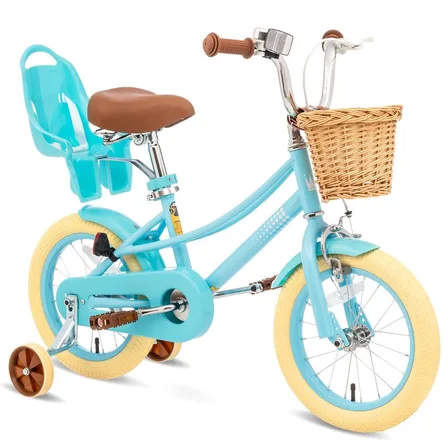
 Pink Girls' 12/14/16" Bike by XJD – Basket & Doll Seat
The 12-, 14- and 16-inch choices cover XBikes’ earliest independent-rider size ranges, but each requires measured-height and hands-on fit checks. The named doll seat must not be treated as a child-passenger seat.
 24-Inch Purple XJD Beach Cruiser Bike with U-Brake
This 24-inch beach cruiser is a comparison point for riders measuring 54–64 inches under the XBikes guide, generally ages 10–14, not a bicycle or passenger solution for a baby.
 Blue XJD Freestyle BMX Bike, 20-Inch – No Pegs
This 20-inch kids’ BMX bike corresponds to the XBikes 48–60-inch, ages 7–12 starting range. It is not relevant for a baby or a child requiring an earlier wheel size.
The Pink Girls' 12/14/16" Bike by XJD – Basket & Doll Seat is the only supplied option spanning the 12-, 14- and 16-inch starting points. Compare the child’s measured height with the corresponding row, then check stand-over, reach and control on the selected size. Its doll seat is named for a doll; do not treat it as a child-passenger seat.
The Blue XJD Freestyle BMX Bike, 20-Inch – No Pegs is a 20-inch comparison point, associated in the XBikes guide with ages 7–12 and heights of 48–60 inches (122–152 cm). It is not relevant for a baby or a child who needs a 12-, 14- or 16-inch bicycle.
The 24-Inch Purple XJD Beach Cruiser Bike with U-Brake is a 24-inch comparison point. The guide places that size at ages 10–14 and heights of 54–64 inches (137–163 cm), subject to the same individual checks. It is not a substitute for a smaller first bicycle.
Prepare for the first ride
Use a properly fitting bicycle helmet every time. It should sit level, with its straps adjusted according to the helmet manufacturer’s instructions. Choose a traffic-free practice area, supervise closely and begin with simple starts, controlled stops and putting a foot down.
Follow the exact bicycle manual for assembly, adjustment, maintenance, load limits and torque requirements. If correct setup or brake operation is uncertain, use a qualified bicycle mechanic rather than guessing.
Make the age decision
For a baby, do not select an independent bicycle from age alone; investigate only a purpose-built passenger system whose manual explicitly accepts the child and bicycle. For an independent rider, begin no earlier than the relevant XBikes range—12 inches starts around age 3—then proceed only when measured height, inseam, stand-over, reach, braking and confidence all work on the actual bicycle.
Bikes for your next adventure
-

Black XJD Toddler Bike Helmet, Adjustable – Kids' Protective Helmet
The XJD Toddler Bike Helmet in black is an adjustable protective helmet for kids…$20.39
-

Kids Bike Helmet by XJD for Girls – Pink
The XJD Kids Bike Helmet in Pink is a lightweight multi-sport helmet for girls r…$59.99
$99 -
Girls' Training Wheel Bike by XJD, 12–20 Inch Wheels – Blue
This XJD girls' training wheel bike in Blue covers one of the widest fit ranges …$139
$159