

What age can a baby sit in a bike seat
Most babies should not ride in a bicycle seat before 12 months. Wait until your baby can sit unsupported and steadily control their head and neck while wearing a properly fitted bicycle helmet; then confirm the seat manual, bicycle compatibility, and your pediatrician’s advice.
Age is only the first check
Twelve months is a practical minimum starting point, not an automatic approval. Development varies, and local rules or the seat manufacturer may set a later minimum. A premature baby may also need assessment by corrected developmental age rather than birthday alone.
Do not ride if your baby still slumps, cannot remain upright without support, or loses head control when moving. A helmet adds weight, so observe whether your child can keep their head stable while wearing it. If that ability is uncertain, wait and ask your pediatrician.
What to measure and compare
Before buying or installing a seat, record your child’s current weight and height. Compare those measurements with the exact child-seat manual, including its minimum and maximum limits. XBikes has not been supplied with load limits for a particular baby seat, so no general number should replace the manufacturer’s limits.
- Development: Confirm independent sitting and steady head and neck control.
- Helmet fit: Choose the correct size rather than one to grow into. It should sit level, fit properly, and have straps adjusted according to its manufacturer’s instructions.
- Seat limits: Check the permitted child age, weight, and height in the exact manual.
- Bicycle fit: Verify that the seat and mounting system are approved for the specific bicycle and installation position.
- Rider control: The adult must be able to start, steer, brake, stop, and balance confidently with the changed load.
Check the equipment before riding
Follow the child-seat and bicycle manuals for assembly, mounting points, fastener torque, restraints, foot protection, maintenance, and load limits. These details vary, so do not estimate them. If either manual is missing or compatibility is unclear, have a qualified bicycle mechanic inspect the bicycle and install or verify the seat.
With the bicycle stationary and supported by another adult, place the helmeted child in the seat and adjust every restraint exactly as directed. Check that clothing, straps, hands, and feet cannot reach wheels or other moving parts. Never leave a child unattended in a mounted seat, even briefly, because the bicycle can tip.
Make the first rides conservative
Begin only after every developmental, fit, and compatibility check passes. Choose a short ride in a quiet, controlled area with a smooth surface. Avoid traffic, abrupt maneuvers, and conditions that make traction or control uncertain. Stop immediately if the child slumps, appears uncomfortable, interferes with control, or cannot keep their head steady.
Recheck helmet fit, restraints, mounting security, and your child’s measurements regularly. Growth or a change of bicycle can make a previously acceptable setup unsuitable. Follow the manuals or consult a qualified mechanic rather than improvising adjustments.
How the supplied kids’ bikes relate
The supplied XBikes products are child-operated bicycles, not baby passenger seats. They therefore cannot carry a baby or establish when a baby is ready for a mounted seat. They are useful only as later-stage comparison points, when a child is developmentally ready to ride independently and can complete an individual bicycle fit check.
The Pink 12/14/16/20" XJD Girls Bike with Training Wheels & Basket offers 12 Inch, 14 Inch, 16 Inch, and 20 Inch catalog options. The Blue XJD Freestyle BMX Bike, 20-Inch – No Pegs is a 20-inch kids’ BMX bike. These options illustrate the substantial size progression beyond a baby seat; they are not substitutes for one.
 Blue XJD Freestyle BMX Bike, 20-Inch – No Pegs
A 20-inch kids’ BMX bicycle for a later independent-riding stage, not a baby passenger seat. Use the XBikes 20 Inch starting range and complete an individual fit check.
 Pink 12/14/16/20" XJD Girls Bike with Training Wheels & Basket
Available in 12, 14, 16, and 20 Inch options with training wheels and a basket. It is relevant only for later independent riding, not for carrying a baby.
Fit a child-operated bike separately
When the child eventually progresses to a bicycle, use measured height before age. XBikes’ starting points are: 12 Inch for ages 3–4 and 34–40 in (86–102 cm); 14 Inch for ages 3–6 and 37–45 in (94–114 cm); 16 Inch for ages 4–7 and 40–48 in (102–122 cm); and 20 Inch for ages 7–12 and 48–60 in (122–152 cm).
Those ranges are starting points, not proof of fit. Have the child try the bicycle. Check stand-over clearance, inseam, reach, brake control, and current confidence; never buy an oversized bicycle simply for growth. The product name or wheel label does not override the individual check.
Your next decision
If your baby is under 12 months, cannot sit unsupported, or lacks steady helmeted head control, wait. If all three checks pass, compare the baby’s measurements with the exact seat limits, confirm bicycle compatibility and installation from both manuals, and ask a pediatrician or qualified mechanic wherever readiness or setup remains uncertain.
Bikes for your next adventure
-
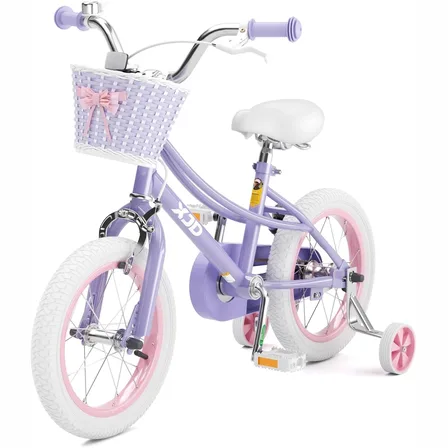
Girls' Training Wheel Bike by XJD with Basket – Purple
If you're shopping for a first bike for a girl roughly 3 to 12 years old (91–152…$75.99
-
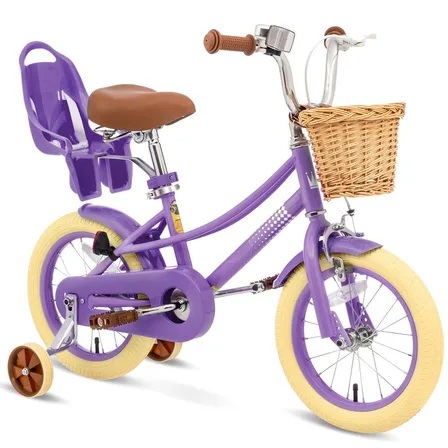
XJD Girls' Bike with Training Wheels, 12/14/16/20 Inch – Purple
The XJD girls' bike with training wheels in Purple is built to grow with your ri…$139
$159 -

Black XJD Toddler Bike Helmet, Adjustable – Kids' Protective Helmet
The XJD Toddler Bike Helmet in black is an adjustable protective helmet for kids…$20.39