

What age is 18 inch frame bike for
An 18-inch kids’ bike, when 18 inches refers to wheel size, is a starting point for ages 5–9 and heights 43–52 in (109–132 cm). If 18 inches refers to the frame, age cannot be determined from that number alone; measure the child and arrange an individual fit check.
First confirm what “18 inch” describes
On children’s bikes, an inch label often identifies wheel size, but “18-inch frame” can mean a frame measurement instead. Those are not interchangeable measurements. Check the bicycle, packaging or exact product manual to see whether the stated 18 inches refers to the wheels or the frame.
If it is an 18-inch wheel bike, use the XBikes range of ages 5–9 and rider heights 43–52 in (109–132 cm) only as an initial screen. If it is genuinely an 18-inch frame, do not assign an age from the supplied wheel-size table. Frame shape and geometry affect fit, so the child must try that exact bicycle.
Measure height before comparing sizes
Have the child stand without shoes, upright against a wall, with feet flat and eyes facing forward. Mark the top of the head and measure vertically from the floor. Compare that result with the 43–52 in (109–132 cm) starting range for 18-inch wheels.
Age is secondary. A tall five-year-old and a shorter nine-year-old can need different bikes despite both falling within the broad age range. A child outside the stated height range should be compared with the adjacent wheel-size starting points rather than moved automatically to an 18-inch bike.
| Wheel size | Starting age | Rider height |
|---|---|---|
| 16 Inch | 4–7 | 40–48 in / 102–122 cm |
| 18 Inch | 5–9 | 43–52 in / 109–132 cm |
| 20 Inch | 7–12 | 48–60 in / 122–152 cm |
The overlapping ranges are intentional starting points, not proof that two sizes fit equally well. When a measurement falls in an overlap, the child’s position and control on each actual bike should decide.
Check inseam, stand-over and reach
Measure inseam with the child standing in socks, feet slightly apart and back against a wall. Place a firm, thin book between the legs, raise it gently to simulate a saddle, then measure from the floor to the book’s top edge. Compare that measurement with the stand-over clearance and adjustment information in the exact bicycle’s manual; no universal clearance number is assumed here.
During a supervised try-on, confirm that the child can stand over the bicycle without being forced onto tiptoes or against the frame. Seated, the rider should reach the handlebar without stretching, twisting forward or locking the elbows. The child must also be able to steer smoothly and operate the brakes comfortably with the controls adjusted as the product manual permits.
Let present control settle the decision
A suitable size should allow the child to start, stop, turn and remain balanced with calm, repeatable control. Current confidence matters: a hesitant rider may handle a smaller option more effectively, while a capable rider still should not be placed on an oversized bicycle merely to leave room for growth.
- Reject a bike if stand-over position is uncomfortable or unstable.
- Reject it if the handlebar or brake controls cannot be reached and used reliably.
- Do not rely on age, the wheel label or expected future growth when the trial fit shows poor control.
- For assembly, adjustments, compatibility or torque, follow the exact product manual or use a qualified bicycle mechanic.
How the supplied catalog bikes help
Neither supplied product has an 18 Inch SKU, so these bikes are nearest-size comparison points, not substitutes for an 18-inch wheel bike. They can help a parent compare an adjacent 16 Inch option and, where available, a 20 Inch option after measuring the rider and checking the actual fit.
XJD Light Purple Girls Bike with Basket, Training Wheels, 12/14/16/20 Inch is listed in Training Wheel Bikes, with available SKU labels of 12 Inch, 14 Inch and 16 Inch. Despite “20 Inch” appearing in its exact catalog title, 20 Inch is not among the supplied available SKU labels, and no 18 Inch option is supplied.
Girls' Training Wheel Bike by XJD, 12–20 Inch Wheels – Blue is also listed in Training Wheel Bikes. Its supplied available SKU labels are 12 Inch, 14 Inch, 16 Inch and 20 Inch, allowing comparison on both sides of 18 Inch, but neither adjacent size should be treated as equivalent to it.
These particular options are relevant because their verified SKU labels provide nearby wheel sizes for a practical fit comparison when an exact 18 Inch option is absent.
 XJD Light Purple Girls Bike with Basket, Training Wheels, 12/14/16/20 Inch
A Training Wheel Bikes option with supplied 12 Inch, 14 Inch and 16 Inch SKUs. Its 16 Inch version is a nearest-size comparison point; no 18 Inch SKU is supplied.
 Girls' Training Wheel Bike by XJD, 12–20 Inch Wheels – Blue
A Training Wheel Bikes option with supplied 12 Inch, 14 Inch, 16 Inch and 20 Inch SKUs. The 16 Inch and 20 Inch versions bracket 18 Inch for comparison but are not equivalent substitutes.
What to do next
- Confirm whether the 18-inch label means wheel size or frame size.
- Measure the child’s standing height and inseam.
- If it means wheel size, compare the height with 43–52 in (109–132 cm).
- Have the child try the exact bike and assess stand-over, reach, braking, balance and confidence.
- Choose an adjacent size only when its own fit is better; do not buy larger solely for growth.
Before riding, add a properly fitting bicycle helmet that sits level, with its straps used according to the helmet manufacturer’s instructions. The final decision is simple: consider an 18-inch wheel bike for a rider in the starting range only if the hands-on fit confirms full control; an 18-inch frame requires its own trial and cannot be matched to an age from wheel size alone.
Bikes for your next adventure
-
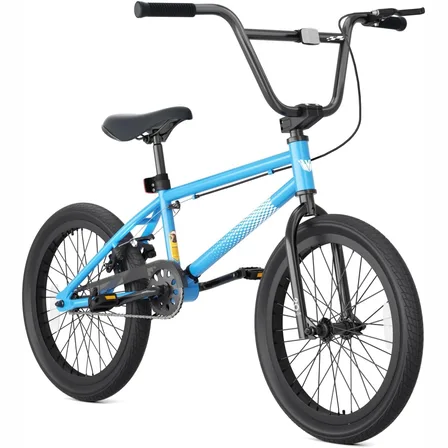
Blue XJD Freestyle BMX Bike, 20-Inch – No Pegs
The XJD 20-Inch Blue Freestyle BMX is an entry-level BMX bike for boys and girls…$189.99
-
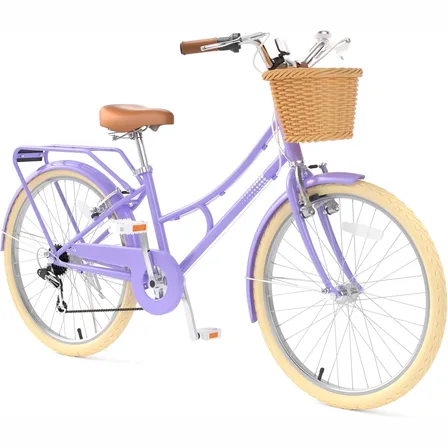
24-Inch Purple XJD Beach Cruiser Bike with U-Brake
The XJD 24-Inch Purple Beach Cruiser is built for girls and young women roughly …$159.99
-

26-Inch XJD Beach Cruiser Bike for Girls – Purple, V-Brake
This XJD 26-inch purple beach cruiser is sized for big kids and teens — suggeste…$218.49
$229.99