

When to buy a child's first bike
Buy a child’s first bike when they can confidently follow simple directions and the bike fits their body now—not when they reach a particular birthday.
Use readiness and fit together
Age can suggest a starting wheel size, but it cannot decide whether today is the right time. A child should be willing to try, able to pay attention, and comfortable practising basic steering, stopping and balance with close adult supervision.
Do not buy an oversized bicycle for future growth. A bike that is too large can make starting, stopping and steering harder. The right first bike is one the child can control at their present height, inseam, reach and confidence level.
Measure before you compare bikes
- Measure standing height: Have the child stand without shoes against a wall, looking straight ahead. Measure from the floor to the top of the head.
- Measure inseam: With feet slightly apart, measure from the floor to the crotch. Use this measurement when checking stand-over clearance.
- Check reach: On the actual bicycle, the child should reach the handlebar without stretching excessively or losing a controlled riding position.
- Check brake control: If the bike has hand-operated brakes, confirm that the child can comfortably reach and operate them.
Write the measurements down rather than relying on clothing size or age. Because frame shapes and adjustment ranges can vary, wheel size alone never completes the fit check.
Choose a wheel-size starting point
| Wheel size | Age starting point | Rider-height starting point |
|---|---|---|
| 12 Inch | 3–4 | 34–40 in / 86–102 cm |
| 14 Inch | 3–6 | 37–45 in / 94–114 cm |
| 16 Inch | 4–7 | 40–48 in / 102–122 cm |
| 18 Inch | 5–9 | 43–52 in / 109–132 cm |
| 20 Inch | 7–12 | 48–60 in / 122–152 cm |
| 24 Inch | 10–14 | 54–64 in / 137–163 cm |
| 26 Inch | Youth and adults | Over 60 in / 153 cm |
Overlapping ranges are normal. Begin with measured height, then compare inseam, stand-over space, reach, brake control and confidence on each candidate. If age points toward one size but the child cannot control that bike comfortably, age does not override the fit check.
Try the bicycle before buying
Have the child stand over the bike and verify that they have usable clearance rather than being pressed against the frame. Then check that they can hold the handlebar, turn it without strain, place themselves in a stable starting position and operate the braking controls provided on that bicycle.
Observe rather than prompting the child to say the bike feels fine. Stretching for the controls, struggling to hold the bicycle upright, or appearing frightened by its size are reasons to pause and compare another fit. If the child fits physically but is not ready to practise, waiting is reasonable.
How the supplied XBikes options compare
These catalog options make the timing decision more concrete because they cover several wheel-size starting points: 12, 14, 16, 20 and 24 inches. They help you compare the child’s current measurements with an available size before arranging an individual fit check.
 Pink Girls' 12/14/16" Bike by XJD – Basket & Doll Seat
Offers 12 Inch, 14 Inch and 16 Inch labels, making it relevant for comparing several smaller first-bike starting points after measuring the child and completing an individual fit check.
 24-Inch Purple XJD Beach Cruiser Bike with U-Brake
A 24-inch beach cruiser with a U-brake, relevant as a later-size comparison for riders whose measured height falls near the supplied 24-inch starting range.
 Blue XJD Freestyle BMX Bike, 20-Inch – No Pegs
A 20-inch kids’ BMX bike without pegs, relevant when the rider’s measured height points toward 20 inches and an individual control and fit check confirms suitability.
Pink Girls' 12/14/16" Bike by XJD – Basket & Doll Seat is the directly relevant option for a smaller first-bike comparison because its available labels are 12 Inch, 14 Inch and 16 Inch. Match the child’s measured height to the table first, select the corresponding label for comparison, and still check stand-over, reach, brake control and confidence.
Blue XJD Freestyle BMX Bike, 20-Inch – No Pegs is relevant only when a 20-inch starting point fits the rider: ages 7–12 and heights 48–60 in / 122–152 cm. Its title identifies it as a 20-inch kids’ BMX bike without pegs; those catalog facts do not establish individual fit.
24-Inch Purple XJD Beach Cruiser Bike with U-Brake is a later-size comparison for riders near the 24-inch starting point: ages 10–14 and heights 54–64 in / 137–163 cm. Its supplied catalog facts identify a beach cruiser with a U-brake, so confirm that the child can reach and operate that braking control.
If measurements indicate 18 or 26 inches, none of these supplied products has that exact wheel size. The listed models are nearest-size comparison points only, not substitutes; do not treat a smaller or larger wheel size as equivalent.
What to do before the first ride
- Repeat the fit check after any seat or handlebar adjustment allowed by the exact product manual.
- Follow that manual for assembly, maintenance, compatibility, load limits and torque. If anything is unclear, use a qualified bicycle mechanic.
- Choose a properly fitting bicycle helmet. It should sit level, with its straps adjusted according to the helmet manufacturer’s instructions.
- Begin in a flat, open area away from traffic and obstacles, with close adult supervision.
Buy now only if the child is willing to learn and can control a correctly sized bicycle during the hands-on check. Otherwise, record the measurements, wait, and repeat the same readiness and fit test later.
Bikes for your next adventure
-
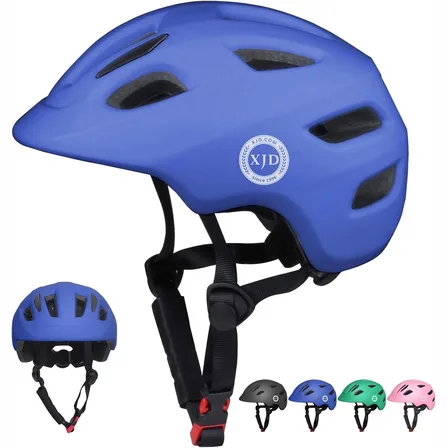
Blue XJD Kids' Bike Helmet, Adjustable Fit – Sizes XS & S
The Blue XJD Kids' Bike Helmet is a lightweight, adjustable helmet for toddlers …$20.39
-
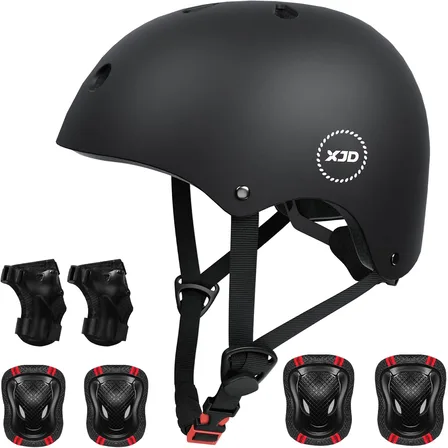
XJD Kids Helmet & Pad Set – Black, S/M/L
This XJD Kids Helmet & Pad Set in Black is designed for kids aged 3 to 8, pairin…$23.79
$27.99 -

Kids Bike Helmet by XJD for Boys & Girls – Black, Blue, Green, Pink, Purple
The XJD Kids Bike Helmet covers a wide 2-to-8-year age range thanks to two head-…$59.99